
The Strongest Leaders Aren’t the Smartest
Curiosity in leadership is more valuable than always having the right answer.
Strong leaders do not prove their worth by solving every problem themselves.
Instead, they ask questions that help other people think, decide, and lead with greater confidence.
For a long time, I thought leadership meant having the answers.
If someone came to me with a problem, I solved it.
When my team had a question, I answered it.
If a client became stuck, I found the solution.
I believed that was my job.
After all, isn’t that what leaders are supposed to do?
Then, one day, I noticed something.
The more answers I gave, the more questions people asked.
Every decision came back to me.
Each challenge landed on my desk.
Meanwhile, every problem waited for my approval.
Without realizing it, I had become the answer to everything.
As a result, I had also become the bottleneck.
That experience taught me one of the most important lessons of my leadership journey.
Leadership is not about having better answers.
It is about asking better questions.
Why Is Curiosity Important in Leadership?
Curiosity in leadership creates ownership.
When leaders immediately solve every problem, people learn to wait for answers.
Why would they think deeply when someone else will always decide?
However, thoughtful questions create a different experience.
People begin exploring possible solutions.
Their confidence grows.
Critical thinking improves.
In addition, ownership increases because the person participates in finding the answer.
That is what great leadership looks like.
It does not create followers who wait.
It creates thinkers who can move forward.
Answers Can Create Dependence
Providing an answer often feels efficient.
Someone asks a question.
You respond.
The problem disappears.
At least for the moment.
However, quick answers can create a long-term cost.
The employee learns that the leader is the safest source of direction.
Soon, similar questions return.
The leader becomes involved in more details.
Meanwhile, the employee receives fewer opportunities to practice judgment.
Over time, the pattern becomes normal.
The team asks.
The leader answers.
Everyone keeps moving, but no one else becomes stronger.
Eventually, the owner complains that nobody takes initiative.
Yet the business may have trained people to seek answers instead of developing them.
That is why curiosity in leadership matters.
A thoughtful question may take longer today.
However, it can reduce dependency tomorrow.
Questions Create Ownership
Consider what happens when someone brings you a problem.
You could immediately explain what to do.
Alternatively, you could ask:
“What have you already considered?”
That one question changes the conversation.
Now the person must examine the situation.
They must organize their thoughts.
They may identify options they had not yet said aloud.
Most importantly, they begin participating in the decision.
Ownership grows when people help create the solution.
This does not mean leaders should withhold information or allow avoidable mistakes.
Sometimes the team genuinely needs an answer.
Still, the leader should first decide whether the moment requires direction or development.
Direction solves the immediate problem.
Development strengthens the person solving it.
Great leaders know when to provide each one.
The Question Behind the Question
One of my favorite moments with clients happens when they ask something like:
“Can I afford to hire?”
I could answer with a simple yes or no.
Instead, I usually ask:
“What would hiring allow you to do that you cannot do today?”
Suddenly, the conversation changes.
We are no longer discussing payroll alone.
Now we are talking about capacity.
Leadership.
Growth.
Vision.
The original question was financial.
However, the deeper question may involve time, opportunity, or the owner’s role in the business.
Most questions people ask are not the complete question.
They are often the doorway to a better conversation.
Curious leaders do not rush through that doorway.
They explore what is behind it.
Curiosity Slows You Down in the Best Way
Business rewards action.
Leadership rewards understanding.
Those are not always the same thing.
When something goes wrong, many leaders ask:
“How do we fix it?”
Curious leaders also ask:
“What can we learn from it?”
When someone makes a mistake, the first reaction may be:
“Who caused this?”
A more useful question could be:
“What allowed this to happen?”
When revenue drops, the immediate response may be:
“How do we sell more?”
Curiosity creates room to ask:
“What changed?”
That difference matters.
Fast action can treat a symptom.
Better understanding can address the cause.
Curiosity creates space to think, observe, and challenge the first explanation.
That space may prevent a quick answer from becoming the wrong answer.
Curiosity Is Not Indecision
Some leaders worry that asking more questions will make them appear uncertain.
They fear the team will lose confidence if the leader does not respond immediately.
However, curiosity is not the same as indecision.
Indecision avoids responsibility.
Curiosity improves understanding before responsibility is exercised.
A curious leader can still make a firm decision.
The difference is that the decision is informed by more than the leader’s first reaction.
Curious leaders gather perspective.
They test assumptions.
They invite information from people closer to the work.
Then, once enough is known, they act.
That is not weakness.
It is disciplined leadership.
The Curious Leader Framework
One habit I have developed is something I call The Curious Leader Framework.
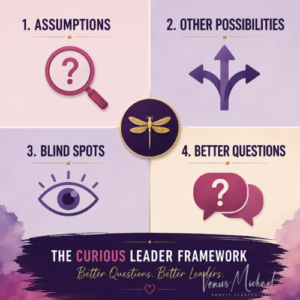
Whenever I face a challenge, I try to ask four questions before offering an opinion.
These questions help interrupt assumptions, uncover blind spots, and create better conversations.
Question One: What Am I Assuming?
Assumptions are dangerous because they often feel like facts.
A client did not respond.
You assume they are unhappy.
An employee missed a deadline.
You assume they are careless.
Sales slowed down.
You assume marketing is failing.
Each explanation may be correct.
However, it may also be incomplete.
Before reacting, ask:
What am I treating as true without enough evidence?
What facts do I actually have?
What story have I added?
The moment you question an assumption, you create room for better thinking.
That is one of the greatest benefits of curiosity in leadership.
It helps leaders separate what they know from what they believe.
Question Two: What Else Could Be True?
Business problems rarely have only one explanation.
The first answer is usually the most obvious one.
The second answer is often more valuable.
Perhaps the employee missed the deadline because priorities conflicted.
Maybe the client is silent because they are overwhelmed rather than dissatisfied.
Revenue may have dropped because buying behavior changed, not because the sales team stopped performing.
Asking what else could be true does not mean avoiding accountability.
It means refusing to decide on one narrow interpretation.
This question expands perspective.
It also lowers the risk of solving the wrong problem.
Question Three: What Am I Not Seeing?
Every leader has blind spots.
The strongest leaders do not pretend otherwise.
Instead, they actively look for missing information.
They invite different perspectives.
They ask for feedback.
In addition, they listen to people who see the work from another position.
A leader may understand the strategy but miss the operational burden.
The owner may see the deadline but not the conflicting priorities.
A manager may see resistance but not the fear driving it.
Ask:
Who sees something I do not?
Whose perspective is missing?
What information would change how I understand this?
Curiosity does not eliminate blind spots.
However, it makes leaders less likely to defend them.
Question Four: What Question Haven’t I Asked Yet?
Sometimes the breakthrough does not come from another answer.
It comes from a better question.
Perhaps the team is discussing how to complete a project.
The missing question may be:
“Should we be doing this at all?”
Maybe everyone is debating which person should own a process.
A better question could be:
“Why does this process require so many handoffs?”
The quality of a business often mirrors the quality of the questions being asked inside it.
Weak questions keep teams focused on symptoms.
Stronger questions reveal assumptions, priorities, and better options.
When a conversation feels stuck, stop searching for another answer.
Look for the question that has not yet been asked.
Certainty Feels Good
Curiosity can feel uncomfortable.

That is why many leaders skip it.
Certainty is fast.
Curiosity requires patience.
Certainty protects the ego.
Curiosity challenges it.
A certain leader can end a conversation quickly.
A curious leader may discover that the situation is more complicated than expected.
That can feel vulnerable.
However, the strongest leaders I know are not afraid to say:
“I don’t know.”
They are confident enough to ask:
“What do you think?”
There is more strength in that question than many leaders realize.
It communicates that another person’s thinking matters.
It also creates room for that person to practice leadership.
Curiosity Builds Psychological Safety
People are more likely to share information when they believe the leader genuinely wants to understand.
A defensive response teaches employees to stay quiet.
An immediate correction teaches them to filter ideas.
By contrast, thoughtful questions make it safer to surface concerns.
Curious leaders say:
“Tell me more.”
“What am I missing?”
“How did you reach that conclusion?”
“What would you recommend?”
These questions show that the conversation is not only about proving who is right.
It is about understanding the situation well enough to move forward.
As psychological safety grows, problems surface earlier.
Ideas become more honest.
Employees become more willing to challenge assumptions.
Therefore, curiosity does more than improve individual decisions.
It improves the quality of information moving through the business.
The Leader Does Not Need to Be the Smartest Person in the Room
Many entrepreneurs built their businesses because they were excellent at the work.
They knew the service.
They solved the problems.
Their knowledge created early success.
However, growth eventually requires a different identity.
The founder can no longer remain the answer to everything.
The business needs more people who can evaluate, decide, and lead.
That transition can be uncomfortable.
Being the expert feels valuable.
Being the questioner may feel less impressive.
Yet leadership is not about proving you are the smartest person in the room.
It is about making the room smarter because you are in it.
Curiosity helps leaders draw out knowledge that already exists across the team.
It turns individual expertise into shared intelligence.
Curiosity Expands Leadership Capacity
The fourth pillar of The Dragonfly Effect™ is Capacity.
People often assume capacity comes from hiring more employees.
Sometimes it does.
However, leadership capacity also grows when other people learn how to think independently.
Every time you ask a better question instead of providing a quick answer, you create a development opportunity.
You teach someone to examine assumptions.
You encourage them to consider alternatives.
They begin identifying missing information.
Eventually, they start asking better questions without you.
That is how organizations grow beyond the person who started them.
Not because the founder works harder.
Instead, growth happens because the founder stops believing they must be the smartest person in every room.
Great Leaders Create Thinkers
One of the greatest compliments I have ever received was not about my bookkeeping.
It was not about financial advice or strategy.
A client once told me:
“I find myself asking the questions you would ask, even when you are not in the room.”
That is leadership.

It is not creating dependence.
It is creating transformation.
A strong leader helps people think differently long after the conversation ends.
The person does not need the leader beside them for every decision.
Instead, they begin using stronger questions on their own.
That is the kind of leader I want to become.
It is also the kind of leader I want my clients to become.
Coaching With Questions
When someone brings you a problem, try using a simple sequence.
First, ask:
“What is happening?”
Then ask:
“What have you already tried?”
Next, explore:
“What options do you see?”
Continue with:
“What are the risks of each option?”
Finally, ask:
“What do you recommend?”
This structure helps the person move from describing the problem to evaluating a solution.
It also allows the leader to understand how the person is thinking.
If their reasoning misses something important, the leader can coach the gap.
That creates a much stronger learning opportunity than simply answering.
Know When to Ask and When to Tell
Questions are powerful.
However, they are not appropriate in every situation.
A leader should provide clear direction when:
- Safety is at risk
- A legal or ethical standard applies
- The employee lacks essential information
- Time is genuinely critical
- The decision exceeds the employee’s authority
- The leader has context the employee cannot access
- A firm boundary must be reinforced
Curious leadership does not mean turning every conversation into a coaching exercise.
It means using questions intentionally rather than answering automatically.
Sometimes the most helpful response is:
“Here is what we need to do.”
At other times, the most helpful response is:
“What do you think we should do?”
Strong leaders learn the difference.
A Challenge for This Week
The next time someone asks you a question, do not answer immediately.
Pause.
Then try asking:
“What do you think?”
Or:
“What have you already considered?”
You could also ask:
“If you were in my position, what would you do?”
Listen carefully to the response.
You may be surprised by how often the person already has a strong answer.
They may need permission to trust their judgment.
Afterward, resist the urge to replace their solution with your preferred version simply because it is different.
Instead, evaluate whether their approach is reasonable, aligned, and safe.
Confidence grows through practice.
People cannot become stronger decision-makers if the leader continues reclaiming every decision.
Conduct a Curiosity Audit
At the end of the week, review several leadership conversations.
Ask yourself:
- How often did I answer immediately?
- Where could I have asked a better question?
- Did I listen long enough to understand?
- Which assumptions affected my response?
- Whose perspective did I overlook?
- Did people leave with more clarity?
- Did my response build ownership or dependence?
- What question helped create the best conversation?
The goal is not to eliminate answers.
It is to notice when an answer solves the moment but weakens the person.
Over time, this awareness changes how leaders respond.
Questions become more intentional.
Conversations become more useful.
Meanwhile, the team becomes more capable.
Venus’ Bottom Line
Leadership is not measured by how many answers you have.
It is measured by how many people leave a conversation thinking more clearly than when they arrived.
Answers solve today’s problem.
Questions develop tomorrow’s leaders.
The strongest leaders do not build businesses where everyone depends on their knowledge.
They build cultures where people know how to think, question, learn, and decide.
Because businesses do not become extraordinary when one person has all the answers.
They become extraordinary when curiosity becomes part of the culture.
And every curious culture begins with one leader willing to ask a better question.


