
What Causes Cash Flow Problems in Profitable Businesses?
Business cash flow problems can be especially confusing when a company is profitable on paper.
One of the most confusing conversations I have with business owners usually starts like this:
“Venus, my accountant says we had a great year.”
Then comes the pause.
“But if we had such a great year, why does it feel like we’re constantly running out of money?”
It is a fair question.
After all, profitability is supposed to mean success.
So why are profitable businesses still stressing over payroll?
Why are they putting expenses on credit cards?
Why are they delaying hiring?
Why are they lying awake wondering if the next slow month is going to hurt?
Because profit and cash are related.
They are just not the same thing.
And confusing the two can quietly create some of the biggest financial challenges a business will ever face.
Why Business Cash Flow Problems Happen in Profitable Companies
Cash flow problems in profitable businesses usually arise because profit measures performance over time, whereas cash flow reflects what is available today.
A business can look profitable on paper while still running out of cash in real life. That happens when money is tied up in unpaid invoices, inventory, equipment, debt payments, taxes, payroll, or expenses that occur before revenue is collected.
Your Profit and Loss statement tells the story of your business.
Your bank account tells the story of your options.
Those stories do not always match.
Profit and Cash Are Not the Same Thing
Most entrepreneurs grow up hearing one simple message:
“If the business is profitable, you’re doing well.”
Technically, that may be true.
Practically, it is incomplete.
Let’s imagine two businesses.
Both earn $1 million in revenue.
Both show a healthy profit.
One has six months of operating cash in the bank.
The other has almost nothing because every dollar is tied up in inventory, unpaid invoices, equipment purchases, debt payments, and taxes.
On paper, they look similar.
In real life, they feel completely different.
One owner sleeps peacefully.
The other refreshes the bank account every morning before getting out of bed.
Same profit.
Completely different experience.

Cash Has a Timing Problem
One of the biggest lessons I have learned as a CFO is this:
Money rarely moves when you expect it to.
Clients pay late.
Vendors want to be paid early.
Payroll does not care whether your customer paid yesterday or three weeks from now.
Taxes always seem to arrive faster than expected.
Large expenses tend to travel in groups.
Business owners often assume cash problems mean they are failing.
More often, they are experiencing a timing problem they never planned for.
That is why profitability alone does not create peace of mind.
A business can be profitable and still be under pressure if cash is not available when decisions need to be made.
The Cash Flow Loop
I like to think about cash flow as a loop rather than a straight line.
Money comes in.
Money waits.
Money leaves.
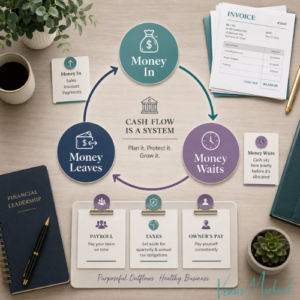
The question is not simply whether money is entering the business.
The question is whether it stays long enough to support the business you are trying to build.
Every decision affects that loop.
Pricing affects it.
Payment terms affect it.
Payroll affects it.
Debt affects it.
Software affects it.
Hiring affects it.
Equipment affects it.
Inventory affects it.
Owner distributions affect it.
One decision by itself rarely creates a cash flow crisis.
Hundreds of small decisions made without a clear plan often do.
Growth Can Make Cash Flow Worse
This is the part that surprises people.
Growth usually requires cash before it produces cash.

You hire before the additional revenue arrives.
You purchase equipment before using it.
You spend on marketing before new clients sign.
You increase inventory before customers buy.
Growth is expensive.
That means the faster your business grows, the more intentional your cash management has to become.
I have seen businesses double their revenue while feeling more financially stressed than ever.
Not because growth was bad.
Because they outgrew the systems that had supported them up to that point.
That is why more revenue is not always the answer.
Sometimes more revenue makes the cash problem move faster.
Profit Is the Score. Cash Is the Fuel.
Imagine driving across Texas.
Your dashboard says the car is performing beautifully.
The engine is running perfectly.
Oil pressure looks great.
Everything appears healthy.
But your gas tank is almost empty.
Would you keep driving simply because the dashboard looked good?
Of course not.
You would stop for fuel.
That is exactly how business works.
Profit tells you how efficiently the engine is running.
Cash determines whether you can keep moving.
You need both.
A profitable business without cash is like a high-performing car with an empty tank.
It may look good for a while.
But eventually, it stops.
The Real Goal Is Not Just More Cash
This may seem unusual coming from someone who spends so much time talking about cash flow.
The goal is not simply to accumulate more cash.
The goal is to create enough predictability, so you stop making decisions out of fear.
Fear creates expensive decisions.
It causes panic discounting.
It delays hiring.
It encourages unnecessary debt.
It makes owners hold onto bad clients because they are worried about losing revenue.
Confidence creates better businesses.
And confidence comes from clarity.
Not just clarity around profit.
Clarity around cash.
A Better Question to Ask
Instead of asking:
“Why don’t I have enough money?”
Try asking:
When does money enter my business, when does it leave, and what decisions are creating the gap?
That question changes the conversation.
It moves you away from panic and toward patterns.
It helps you understand whether the issue is pricing, payment timing, spending, payroll, debt, tax planning, owner distributions, or growth outpacing cash flow.
The real answers rarely live in the balance of your checking account.
They live in the patterns behind it.
Venus’ Bottom Line
Profit tells you whether your business is working.
Cash flow tells you whether your business can keep working tomorrow.
Healthy businesses need both.
Because you cannot build a sustainable company on profitability alone.
You also have to protect the cash that gives every good decision room to breathe.
So before you assume your business is failing, ask yourself this:
Is this a profit problem, or a cash-timing problem?
The answer may change the way you lead.