
Trust Is Built Long Before It Is Needed
Employee trust in leadership is not created during one dramatic moment.
Instead, it is built or quietly damaged through hundreds of ordinary decisions that leaders may barely notice.
One of the biggest misconceptions about leadership is that trust is something you earn over time.
I see it differently.
Time alone does not create trust.
Repeated experiences do.
Long before your team decides whether they will follow your vision, they are answering a much simpler question.
Can I trust you?
They do not answer that question because of your title.
They do not answer it because your name appears on the door.
Instead, they answer it by watching what happens around you.
Do your words match your actions?
Do expectations remain steady?
Can people tell you the truth without being punished for it?
Do you keep your commitments?
Do you treat mistakes as opportunities to learn or reasons to blame?
Leadership is experienced long before it is believed.
Why Do Employees Trust Some Leaders but Not Others?
Employees develop trust in leadership when a leader’s actions consistently match their words.
People want to know where they stand.
They want expectations to remain clear.
They need to know that standards will not change based on the leader’s mood, pressure, or personal preference.
Trust also grows when employees can raise concerns, admit mistakes, and ask questions without fear of embarrassment or retaliation.
People do not trust leaders because those leaders are perfect.
They trust leaders because their behavior is dependable.
Predictability reduces anxiety.
As a result, employees spend less energy protecting themselves and more energy solving problems.
That is where psychological safety begins.
Trust Is Like a Bank Account
Years ago, I started thinking about trust as a bank account.
Every interaction with another person becomes a transaction.
Sometimes you make a deposit.
Other times, you make a withdrawal.
You keep your word.
Deposit.
You admit that you were wrong.
Deposit.
You listen before reacting.
Deposit.
You recognize someone’s contribution.
Deposit.
You give honest feedback with respect.
Deposit.
Now consider the opposite.
You cancel a one-on-one for the third week in a row.
Withdrawal.
You promise feedback but never provide it.
Withdrawal.
You say people matter but reward only production.
Withdrawal.
You ask for honesty and then punish someone for telling the truth.
Withdrawal.
You apply one standard to a favorite employee and another to everyone else.
Withdrawal.
The challenge is that leaders often fail to notice these transactions while they are happening.
A missed commitment may feel minor.
However, repeated inconsistency changes how people experience the relationship.
By the time the leader desperately needs trust, the account may already be overdrawn.
Employee Trust in Leadership Is Built Through Small Deposits
Large gestures may feel meaningful.
However, trust usually grows through smaller moments.
It grows when you arrive prepared for a meeting.
It grows when you follow through without being reminded.
Trust increases when you explain a difficult decision instead of hiding behind authority.
It strengthens when you protect an employee who made a reasonable decision using the information available.
Likewise, trust grows when you acknowledge uncertainty instead of pretending to know everything.
These moments rarely feel dramatic.
Still, they create the evidence people use to decide whether your leadership is dependable.
A leader cannot demand trust during a crisis.
The leader can only draw from the trust built before the crisis arrived.
People Are Always Watching
One of the hardest leadership lessons is realizing that your team notices far more than you think.
They notice who receives recognition.
They observe how conflict is handled.
People watch whether you remain calm under pressure.
They notice whether your decisions are consistent.
They also notice whether your values apply to everyone or only when it’s convenient.
Leadership is not performed only during an annual meeting.
It is observed during the ordinary moments between meetings.
Your team watches what happens after someone makes a mistake.
They notice whether bad behavior from a high performer receives a different response.
They observe whether you interrupt, listen, blame, defend, explain, or disappear.
None of these moments stands alone.
Together, they form a pattern.
That pattern becomes your leadership reputation.
Consistency Builds More Trust Than Charisma
Some leaders are highly charismatic.
They inspire people.
They generate excitement.
They can make a room believe in a big idea.
There is nothing wrong with charisma.
However, charisma can attract people while consistency determines whether they stay.

The leaders I respect most are not always the loudest people in the room.
Instead, they are people whose actions rarely surprise me.
I know they will do what they said they would do.
I know they will tell me the truth.
They will own their mistakes.
They will not change the rules without explanation.
That kind of consistency creates something more durable than excitement.
It creates confidence.
Charisma may influence how people feel during a meeting.
Consistency influences how safe they feel after the meeting ends.
The Trust Test
When I evaluate employee trust in leadership, I return to four questions.
I call this framework The Trust Test.
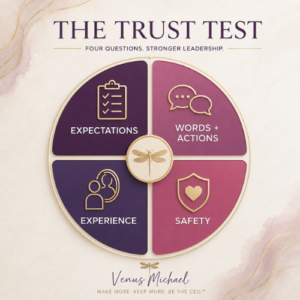
The questions are simple.
However, answering them honestly can reveal the gap between how a leader intends to behave and how employees may experience that behavior.
Question One: Do People Know What to Expect From Me?
Consistency creates confidence.
Unpredictability creates anxiety.
That does not mean leaders must react identically to every situation.
Different circumstances may require different responses.
However, the principles behind those responses should remain steady.
Do employees know how you handle mistakes?
Do they understand what requires your approval?
Can they predict how you will respond to bad news?
Do expectations change depending on who is involved?
When people cannot predict the leader’s reaction, they begin managing the leader instead of managing the work.
They wait.
They hide information.
They soften the truth.
They spend time deciding when and how to approach the leader.
Consequently, the business becomes slower and less honest.
Question Two: Do My Actions Support My Words?
People remember behavior much longer than speeches.
A leader can talk about work-life balance.
However, midnight emails requiring immediate answers communicate something different.
A company may say that innovation matters.
Yet employees will stop experimenting if every imperfect result receives criticism.
Leaders may claim that communication is important.
Still, repeatedly canceling one-on-one meetings tells employees that communication is optional.
The words may sound sincere.
The behavior creates the evidence.
When words and actions conflict, people believe the actions.
Therefore, building trust requires leaders to examine not only what they say but also what their behavior teaches.
Question Three: Would My Team Describe Me the Way I Describe Myself?
This question is uncomfortable.
That is exactly why it is valuable.
You may describe yourself as approachable.
Would your employees agree?
Perhaps you believe you welcome honest feedback.
Do people actually give it to you?
You may see yourself as calm.
What happens when a deadline is missed, or a customer complains?
Leadership is not defined by intention.
It is defined by experience.
Good intentions matter.
However, they do not erase the effect of inconsistent behavior.
The gap between intention and experience is where trust often begins to weaken.
Strong leaders are willing to examine that gap without becoming defensive.
Question Four: Do People Feel Safer or Smaller After Talking With Me?
Every leadership conversation leaves a mark.
People may leave feeling more capable or more dependent.
They may feel encouraged or discouraged.
A conversation can create clarity or confusion.
It can help someone think more confidently or make them afraid to decide again.
Great leaders do not need to make every conversation comfortable.
Accountability may still be necessary.
Standards may still need to be reinforced.
Difficult feedback may still need to be delivered.
The question is whether the person leaves understanding what happened, what needs to change, and whether improvement is possible.
Trust does not require leaders to avoid difficult conversations.
It requires them to handle those conversations in a way that preserves dignity and clarity.
Trust Changes the Speed of Business
Low-trust businesses move slowly.

Every decision requires approval.
Employees protect information.
Mistakes lead to blame.
Conversations become political.
Change creates resistance.
People document every interaction because they expect to be blamed later.
As a result, even simple work becomes complicated.
High-trust businesses move differently.
Employees communicate faster.
Problems surface earlier.
People ask for help before the situation becomes an emergency.
Innovation happens more naturally.
Ownership increases.
Decisions move closer to the people with the right information.
Trust does not eliminate problems.
Instead, it allows people to solve problems together.
Psychological Safety Does Not Mean Lower Standards
Some leaders hear the phrase “psychological safety” and assume it means making everyone comfortable.
It does not.
A psychologically safe workplace can still have high expectations.
In fact, trust makes strong accountability more possible.
Employees can admit that they missed a deadline.
They can explain what went wrong.
They can challenge an assumption.
They can ask for help.
Most importantly, they can surface a problem before it becomes expensive.
Without trust, accountability becomes threatening.
People hide mistakes, protect themselves, and wait until there is no other choice.
With trust, accountability becomes a shared commitment to improvement.
The standard remains high.
Fear stops interfering with the truth.
Trust Creates Real Control
The second pillar of The Dragonfly Effect™ is Control.
People often mistake control for micromanagement.
They believe that leaders create control by reviewing every detail and approving every choice.
However, real control comes from creating an environment where people consistently make good decisions without being watched.
That requires trust.
Trust permits people to think.
It allows them to lead.
It encourages them to take ownership.
Without trust, control becomes control in the worst sense of the word.
The owner becomes the answer to every question.
Employees wait for permission.
Information becomes filtered.
The business slows down.
With trust, standards remain clear while people gain room to act.
That is not less control.
It is a stronger form of it.
The Leader Sets the Emotional Temperature
Teams often mirror the emotional state of their leader.
When the leader becomes defensive, people become cautious.
When the leader remains calm, the team becomes steadier.
A curious leader invites more ideas.
An unpredictable leader encourages silence.
Leadership is not only about making decisions.
It is also about creating an environment where other people can make good decisions.
That is one of the most important things trust accomplishes.
It lowers fear.
When fear decreases, honesty increases.
Problems surface faster.
People take more ownership.
The leader’s emotions do not need to disappear.
However, leaders must learn how to manage those emotions without making the entire team carry them.
How Leaders Quietly Withdraw Trust
Not every trust withdrawal looks dramatic.
Many are ordinary habits.
A leader makes a promise and forgets it.
Someone shares a concern, but the leader becomes defensive.
A decision changes without explanation.
An employee receives feedback only when something goes wrong.
A leader asks for input after already making the decision.
A meeting begins late every week.
A difficult employee receives special treatment because they produce strong results.
Each action may seem small.
Together, they communicate what employees can expect.
Trust rarely disappears through one mistake.
More often, it weakens through repeated evidence that the leader’s words cannot be relied upon.
How to Make Trust Deposits
Trust cannot be repaired through one speech.
It must be rebuilt through behavior.
Start with small, visible actions.
Keep the commitment you already made.
Explain a decision instead of assuming people understand it.
Acknowledge when your behavior created confusion.
Ask a question and listen to the full answer.
Give feedback when something goes well, not only when it goes wrong.
Apply standards consistently.
Admit what you do not know.
Follow up when you say you will.
None of these actions is complicated.
However, repetition turns them into trust.
Conduct a Weekly Trust Review
At the end of the week, do not ask only whether your team trusts you.
Ask two better questions.
What Did I Do That Built Trust?
Review your actions.
Where did your words and behavior align?
When did you remain consistent under pressure?
Did you keep an important commitment?
Did you listen before reacting?
Did you create clarity?
Did you recognize someone’s contribution?
Name the specific deposits.
What Quietly Created a Withdrawal?
Now examine the less comfortable moments.
Did you cancel something important?
Did you avoid a conversation?
Were your expectations unclear?
Did you react defensively?
Did you change direction without explanation?
Did someone leave a conversation feeling smaller?
This is not an exercise in guilt.
It is an exercise in awareness.
Once you see the withdrawal, you can decide how to repair it.
Repair Requires More Than an Apology
An apology matters.
However, trust is not fully restored because a leader says the right words once.
Repair requires changed behavior.
If you repeatedly cancel one-on-one meetings, schedule the next one and protect the time.
If you punished honesty, acknowledge what happened and show that the next honest conversation will be handled differently.
When expectations were unclear, clarify them.
If standards were applied inconsistently, correct the inconsistency.
Employees may forgive a mistake quickly.
Still, they will wait for evidence before changing what they believe.
That is reasonable.
Trust was built through repetition.
Therefore, repair must also happen through repetition.
Venus’ Bottom Line
Trust is one of the few business assets that does not appear on a Balance Sheet.
Yet it influences nearly every number that does.
Trust affects communication.
Productivity.
Retention.
Innovation.
Customer experience.
Decision-making.
Profitability.
Leadership is not measured only by how many people report to you.
It is measured by how safe people feel following you.
Employees do not need perfect leaders.
They need leaders whose behavior gives them a reason to believe what they say.
Because exceptional businesses are not built by people who fear making mistakes.
They are built by people who trust one another enough to do their best work.
So before asking whether your team trusts you, ask a more useful question:
What evidence did my leadership give them this week?