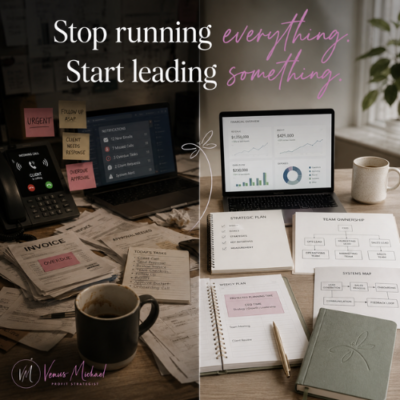
The Day You Stop Running a Business and Start Leading One
To think like a CEO, you must stop measuring your value by how much you personally accomplish. Instead, measure it by the quality of the decisions, systems, and leadership you create.
That shift does not depend on the size of your company.
You do not need a large team or millions of dollars in revenue. In fact, CEO thinking begins with perspective rather than business size.
I can usually tell within the first few minutes of a meeting whether someone is thinking like an operator or a CEO.
Some leaders run multimillion-dollar companies but still operate like employees. Meanwhile, other entrepreneurs lead teams of three with exceptional clarity.
Revenue is not the difference.
Neither are experience or intelligence.
Perspective changes everything.
An operator asks:
What needs to get done today?
A CEO asks:
What kind of business am I building?
Those two questions create very different futures.
What Does It Mean to Think Like a CEO?
To think like a CEO means looking beyond today’s task list.
Rather than measuring success by activity, you measure it by direction. You also consider whether the company is becoming stronger, more sustainable, and less dependent on you.
Most entrepreneurs initially build a business around themselves. That approach makes sense at the beginning because the owner holds the vision, understands the clients, and knows how the work should be completed.
Eventually, however, a company built entirely around one person reaches a ceiling.
Great CEOs build businesses that can thrive because of the systems, people, and decisions they put in place.
The shift may sound subtle.
In practice, it changes everything.
I Know the Operator Trap Because I Lived It
Like many entrepreneurs, I started my business believing hard work could solve almost anything.
Whenever something needed attention, I handled it.
My responsibilities included client emails, bookkeeping, payroll, marketing, networking, administrative work, and problem-solving.
Whenever a fire appeared, I grabbed the hose.
For a while, that approach worked.
Then it stopped working.
Eventually, I had to admit something uncomfortable.
I had not built a business. Instead, I had created a job that happened to be mine.
Even worse, I was becoming the biggest bottleneck in my own company.
Decisions came through me. Problems landed on my desk. Client questions required my attention.
Sound familiar?
Hard work may help you start a business. However, hard work alone will not build one that can grow beyond you.
Busy Is Not the Same as Productive
Our culture celebrates hustle.
A long task list is often treated like proof of success. Yet after years of working with entrepreneurs, I have learned that the busiest person in the company is not always creating the most value.
Often, that person is simply carrying too much.
Activity feels productive because you can see it. Emails get answered, boxes get checked, and problems get handled.
Still, activity without direction creates exhaustion instead of progress.
The goal is not to become better at doing everything.
Instead, become better at deciding what matters.
That is leadership.
How the Operator Trap Develops
Operators spend much of their time reacting.
Their days fill with email, purchase approvals, customer questions, mistakes, and urgent requests. Although those responsibilities may be necessary, they should not become the company’s entire strategy.
Once urgency begins controlling the day, long-term work disappears.
Building gives way to surviving.
Unfortunately, survival can look like dedication from the outside. The owner works hard, helps everyone, and solves every problem.
At the same time, the company learns that all problems are the owner’s responsibility.
Over time, availability becomes the system. Memory becomes the process. Personal energy becomes the business plan.
None of that is sustainable.
How to Think Like a CEO Instead of an Operator
The biggest transformation I see in business owners rarely comes from learning more accounting.
Instead, the transformation begins when they ask different questions.
An operator asks:
What do I need to finish today?
A CEO considers:
What decision would make the next six months better?
When an operator faces a purchase, the question may be:
Can I afford this?
By contrast, a CEO asks:
Does this move the business toward the future I am building?
If a problem appears, the operator wants to know who can solve it.
The CEO looks deeper:
Why does this problem keep returning?
That is what it means to think like a CEO.
CEO thinking does not ignore today’s problems. However, it also works to eliminate tomorrow’s version of those problems.
Operators Solve Problems While CEOs Study Patterns
Consider a client issue that keeps appearing.
An operator handles each complaint as it arrives. A CEO pauses to investigate why the issue persists.
Perhaps the onboarding process is unclear.
Maybe the team lacks authority.
In other cases, expectations are communicated poorly, or the service attracts the wrong clients.
The operator resolves the immediate concern. Meanwhile, the CEO changes the system producing it.
Both roles matter.
However, when the owner never steps out of operator mode, no one studies the larger pattern.
The same principle applies to financial problems.
Suppose cash becomes tight at the same time each month. An operator may transfer money, delay a bill, or push for another sale.
A CEO investigates the cause.
Maybe customers take too long to pay. Perhaps expenses are timed poorly, pricing is too low, or the company lacks a reserve.
A quick fix can help you survive today.
A stronger system changes what happens next month.
The Dragonfly Effect™
One of the core ideas behind The Dragonfly Effect™ is that sustainable growth requires four elements working together.
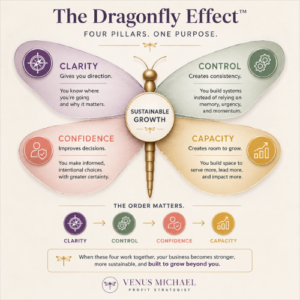
Clarity Gives You Direction
Clarity helps you understand where the business is going and why the destination matters.
Without clear direction, a company can stay extremely busy while moving toward the wrong future.
Control Creates Consistency
Control comes from systems rather than memory, urgency, or momentum.
This does not mean doing everything yourself. Instead, it means building reliable processes that produce consistent outcomes.
Confidence Improves Decisions
Confidence does not require perfect information.
Rather, it grows when you understand the situation well enough to make an intentional choice.
Capacity Creates Room to Grow
Capacity gives the company room to serve more clients, develop the team, and pursue new opportunities.
Many entrepreneurs try to create capacity first. Therefore, they hire employees, purchase software, add services, or increase their own hours.
However, capacity without clarity often creates larger problems.
The order matters:
Clarity. Control. Confidence. Capacity.
Together, those four elements create a more sustainable business.
Think Like a CEO Before Adding Capacity
Hiring someone will not automatically solve unclear leadership.
Likewise, new software cannot repair a broken process, and more clients will not correct poor pricing.
A larger team also provides little relief when every decision still requires the owner’s approval.
Therefore, create clarity before adding capacity.
Start by identifying the role the business actually needs. Next, define the result that role should own.
Then consider the process, decision authority, and measures of success.
Without those answers, growth may simply create more people waiting for you.
A company can become larger while keeping the same small bottleneck.
Sometimes that bottleneck is the owner.
Your Business Should Not Depend on Your Memory
Here is a question I ask clients from time to time:
If you disappeared for two weeks, what would stop?
Some people laugh.
Others do not because they already know the answer.
Approvals may stop first. Soon afterward, the client’s questions, decisions, relationships, and internal processes begin to slow down.
That is not resilience.
It is dependency.
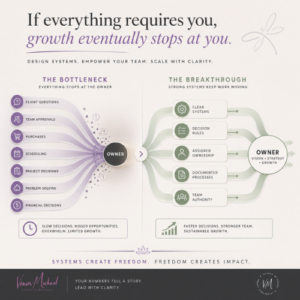
The goal is not to make yourself indispensable. Instead, build a business that can function without constant access to you.
Strong companies are not built around one extraordinary person.
They rely on clear systems that allow ordinary days to produce reliable results.
How to Stop Being the Bottleneck
You do not need to disappear from the company tomorrow.
Nor do you need to delegate everything at once.
Begin by noticing where work becomes stuck.
Consider these questions:
- Which decisions always return to me?
- What information exists only in my head?
- Which approvals could follow a clear rule?
- What problem have I solved more than three times?
- Which task requires my involvement but not my expertise?
- Where is the team waiting instead of deciding?
- What would break if I took a full week away?
After identifying the patterns, choose one area to strengthen.
First, document the process. Then clarify the expected result and assign ownership.
Next, define the limits within which someone else may decide.
Finally, resist the urge to reclaim the work simply because another person handles it differently.
Delegation does not create capacity when the owner continues controlling every detail.
Becoming the Leader Your Business Needs
Leadership is not about having every answer.
Rather, it involves creating an environment where good decisions happen consistently.
Your team should understand the mission. In addition, financial systems should support growth rather than create constant stress.
Clients should experience consistency whether you are having a great day or a difficult one.
Most importantly, the company should reflect your values rather than your availability.
That is the business many entrepreneurs actually want.
They do not want a company that demands every waking hour. Nor do they want one that falls apart whenever the owner takes a vacation.
Instead, they want a business that becomes stronger as leadership improves.
Think Like a CEO by Protecting CEO Time
You cannot think like a CEO when every minute belongs to someone else.
CEO time should not be whatever remains after all other work is complete because the work will never truly be finished.

Instead, schedule time to:
- review financial performance
- study recurring problems
- make important decisions
- plan future capacity
- evaluate priorities
- develop the team
- examine risks
- consider long-term direction
This work may feel less productive than answering email.
However, it often creates far more value.
One strong decision can prevent months of unnecessary effort. Similarly, one improved process may eliminate hundreds of repeated mistakes.
A clear priority can also redirect the entire team.
The CEO’s work is not always visible.
Its results are.
The Question That Brings Season One Together
Throughout this season, we have explored clarity, money, cash flow, revenue, important metrics, artificial intelligence, and better questions.
Together, those conversations lead to one final question:
Am I building a business that depends on me, or one prepared to grow beyond me?
Sit with that question for a moment.
The answer has very little to do with revenue. Instead, it reveals the strength of your leadership.
A company can produce impressive sales while still depending entirely on its owner.
Similarly, it may have employees while requiring one person to make every meaningful decision.
From the outside, that business may look successful. Inside, however, the person at its center may feel exhausted.
Growth is not only about making the company larger.
It is also about strengthening the company
Venus’ Bottom Line
The moment you stop trying to be the hardest-working person in your company and begin becoming its clearest thinker, everything changes.
Decisions improve.
Team members develop.
Confidence grows.
As a result, the business becomes stronger.
That progress does not happen because you started doing more.
It happens because you finally started leading.
Operators prove their value by doing the work. CEOs create value by building a business that works.
Here is what I would like you to think about today:
Is your business becoming stronger because of your leadership, or more dependent on your availability?