Every Dollar You Spend Is an Employee
Learning how to evaluate business expenses helps you decide which costs deserve more resources, which need closer review, and which should be eliminated.
A worthwhile expense creates more value than it consumes.
That value may be financial. However, it may also save time, improve operations, reduce risk, increase capacity, or support a larger strategy.
Most entrepreneurs begin with one question:
Can I afford this?
That question matters, but it does not go far enough.
A better question is:
What job am I hiring this expense to do?
A few years ago, I was reviewing a client’s financial statements when she said something I will never forget.
“I don’t understand why I never have any money left.”
Her revenue was healthy. New clients were coming in, and the company was growing.
At first glance, nothing looked obviously wrong.
There was no enormous purchase draining the bank account. Instead, dozens of smaller expenses had quietly accumulated.
A new software subscription.
A marketing platform.
An online course.
A membership.
An upgraded camera lens.
A virtual assistant.
Another AI tool she wanted to test.
Individually, every purchase seemed reasonable.
Collectively, they were working against her.
So I asked one question:
If these were employees instead of expenses, would you keep all of them on payroll?
She stared at me for a moment.
Then she laughed.
A second later, she said, “Oh wow.”
That conversation changed how she viewed spending.
Honestly, it also changed how I teach business owners to evaluate business expenses.
How to Evaluate Business Expenses
To evaluate business expenses effectively, begin by identifying the job each cost is expected to perform.
An expense should create a result that supports the company.
That does not mean every cost must generate revenue directly.
Your accountant may reduce risk.
A project-management system may save time.
Insurance may protect the company from a serious loss.
A coach may improve the quality of your decisions.
Meanwhile, a team member may create capacity that allows you to focus on higher-value work.
Each expense can create value differently.
Still, every cost should have a purpose.
Too often, business owners look only at the amount available in the bank account.
You may be able to afford another subscription. However, that does not mean the company needs it.
Likewise, you may have enough cash to hire someone while still lacking a clearly defined role.
A marketing opportunity may also fit the budget without supporting your strategy.
Therefore, the better question remains:
What job am I hiring this expense to do?
Stop Thinking About Expenses and Start Thinking About Employees
Imagine your profit and loss statement as a room filled with employees.
Your marketing budget sits in one chair.
Software subscriptions occupy another row.
Payroll gathers around the conference table.
Nearby, you see advertising, rent, accounting, coaching, your CRM, and the newest AI subscription.
Every one of them is working for the company.
Or at least, they are supposed to be.
Now imagine walking into that room once a month to conduct performance reviews.
Who deserves more resources?
Which investment is exceeding expectations?
What expense contributes very little?
Who has been collecting a paycheck without producing meaningful value?
Suddenly, spending becomes less emotional.
Instead, it becomes intentional.
A monthly charge may look harmless on a bank statement. Thinking of that cost as an employee forces you to consider whether it is doing its job.
Use the Expense Interview to Evaluate Business Expenses
I use a framework called The Expense Interview.
Every recurring expense should be able to answer four questions:
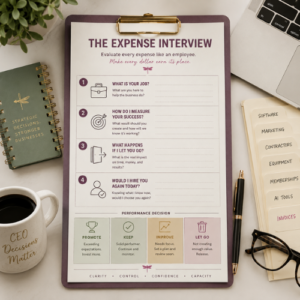
- What is your job?
- How do I measure your success?
- What happens if I let you go?
- Would I hire you again today?
Together, these questions help you evaluate more than price.
They reveal purpose, performance, necessity, and current relevance.
Question 1: What Is Your Job?
When you cannot explain why an expense exists, you may not need it.
“Everyone else uses it” is not a job description.
Neither are these explanations:
- It looked useful
- Someone recommended it
- I might need it someday
- It was on sale
- I already paid for the setup
- I forgot we still had it
A clear job sounds different.
For example:
- This software reduces scheduling time
- This contractor completes work that previously required ten owner hours
- This marketing campaign generates qualified conversations
- This insurance policy protects the company from a specific risk
- This membership provides access to referral partners
- This equipment improves the quality or speed of client delivery
Once the job becomes clear, the expense becomes easier to assess.
Without a defined purpose, you are simply funding activity.
Question 2: How Do I Measure Success?
Imagine paying an employee without ever evaluating performance.
That would sound irresponsible.
Yet many business owners treat expenses exactly that way.
They subscribe, pay, and renew. However, they never define what success should look like.
The measurement does not need to be complicated.
A software tool may be successful when it saves five hours each month.
Marketing may be effective if it produces a certain number of qualified leads.
A membership might earn its place through referrals, education, partnerships, or access.
Meanwhile, an assistant may create value by reducing owner involvement, improving response time, or preventing missed details.
The measurement should match the job.
Do not judge every expense by direct revenue alone.
Instead, decide which result the expense should create. Then review whether that result is actually happening.
Question 3: What Happens if I Let You Go?
This is where the interview becomes interesting.
Some expenses are essential.
Others have become habits.
Many businesses continue paying for subscriptions no one has opened in months.
Marketing strategies remain active even though they no longer fit.
Memberships renew automatically despite limited participation.
Services continue because canceling them feels inconvenient.
Past usefulness does not guarantee current value.
Businesses evolve. Therefore, their expenses should evolve as well.
Ask what would truly happen if the expense disappeared.
Would revenue decline?
Could the team lose an important capability?
Would risk or compliance become a problem?
Could the owner regain time, cash, or mental space?
Is another tool already performing the same job?
Sometimes the answer confirms that the expense is essential.
Other times, nothing meaningful happens.
Both answers are useful.
Question 4: Would I Hire You Again Today?
This may be the most powerful question in the process.
Forget how long you have paid for the expense.
Set aside the original setup cost.
Ignore the time already invested.
Knowing what you know now, would you choose it again today?
When the answer is yes, keep it with confidence.
When the answer is maybe, give the expense a clearer job and a defined review period.
If the answer is no, ask why it remains on payroll.
This question helps you move beyond sunk-cost thinking.
You are not deciding whether the original purchase was foolish.
Instead, you are deciding whether the expense belongs in the business you are building now.
Evaluate Small Business Expenses Before They Accumulate
Very few businesses struggle because of one catastrophic spending decision.
More often, hundreds of smaller decisions were never revisited.
Twenty-nine dollars.
Ninety-nine dollars.
Two hundred dollars.
Five hundred dollars.
None of those amounts feels dangerous by itself.
However, the total changes when those charges repeat across dozens of subscriptions, tools, services, memberships, and commitments.
The individual purchase is not always the problem.
Accumulation is.

Financial clutter works much like physical clutter.
At first, you barely notice it.
Eventually, everything begins to feel heavy.
You may not have one wasteful $10,000 expense. Instead, you may have thirty recurring costs consuming hundreds or thousands of dollars each month.
That is why it is important to evaluate business expenses consistently rather than waiting until cash becomes tight.
Every Expense Has an Opportunity Cost
Every dollar can perform only one job at a time.

When it pays for software you barely use, it cannot build an emergency reserve.
That same dollar cannot reduce debt.
It cannot increase owner’s pay, create profit, fund a future hire, or support a stronger marketing investment.
Money is finite.
Therefore, every spending decision is also a decision not to use that money somewhere else.
Great CEOs understand this.
They are not necessarily cheap.
In fact, many successful companies invest aggressively.
The difference is intention.
Cheap businesses focus only on reducing costs.
Intentional businesses focus on improving returns.
They know when to spend more because an investment is working.
They also recognize when an expense no longer supports the strategy.
A Valuable Expense May Not Produce Immediate Revenue
Do not turn this exercise into a reckless cost-cutting campaign.
Some investments need time to produce results.
Others provide value that may never appear as a separate revenue line.
For example, training may improve future performance.
A strong bookkeeping system can reduce confusion and protect decision quality.
Legal support may prevent an expensive problem.
Better equipment might improve delivery capacity and the client experience.
Likewise, strategic advisory can help an owner avoid a much bigger mistake.
The goal is not to remove anything that fails to generate immediate revenue.
Instead, understand the job, the expected result, and the appropriate timeline.
An expense does not fail simply because it cannot prove itself in thirty days.
It fails when no one knows what it was hired to accomplish.
Businesses That Scale Evaluate Expenses Differently
Sustainable businesses do not always spend less.
Often, they spend more.
However, their significant expenses support a purpose.
Investments connect to a strategy.
Recurring costs continue earning their place.
The conversation shifts from:
What does this cost?
To:
What return should this create?
That return might include:
- revenue
- profit
- time saved
- improved quality
- reduced risk
- stronger retention
- better client experience
- increased capacity
- more consistent delivery
- less owner dependency
Once you define the expected return, you can evaluate performance more fairly.
You can also decide whether the expense needs more time, a different strategy, a smaller commitment, or a termination notice.
Conduct an Expense Performance Review
This month, open your profit and loss statement.
Then review each cost as though it were sitting across the desk from you.
Start with recurring expenses because they often continue without active reconsideration.
Ask:
- What job are you performing?
- What result should you create?
- How will I measure that result?
- What happens if I remove you?
- Would I choose you again today?
- Are you still aligned with my current strategy?
- Is another expense performing the same job?
- Do you deserve more resources, less funding, or termination?
Do not rush through the exercise.
A glance at the P&L will not reveal the entire story.
Review the actual subscriptions.
Check usage.
Talk with your team.
Examine the outcomes.
Then make a decision.
Some expenses will deserve a raise.
Others may need a performance plan.
A few should probably be let go.
Use Cost-Benefit Thinking Instead of Emotion
The U.S. Small Business Administration recommends reviewing money entering and leaving the business. It also explains how cost-benefit analysis can help owners compare the strengths, weaknesses, costs, and possible benefits of a decision.
That does not mean every purchase requires a complicated spreadsheet.
However, spending decisions deserve more than excitement, fear, convenience, or habit.
Before committing, ask:
- What benefit do we expect?
- What will this consume?
- Which alternatives exist?
- How long should the investment take to perform?
- What result would cause us to stop?
- When will we review it?
These questions make it easier to separate strategic investment from financial clutter.
Make Every Dollar Earn Its Place
Some of the biggest financial wins do not come from earning more.
Instead, they come from making better decisions with the money already entering the business.
One canceled subscription will not transform your company.
A better approach to spending can.
When every expense has a job, you gain clarity.
When every recurring cost has a measure of success, you gain control.
As spending becomes more intentional, confidence improves.
Finally, removing financial clutter creates capacity for the investments that matter most.
That is how better spending decisions support a healthier company.
Venus’ Bottom Line
Business owners often spend months trying to increase revenue while ignoring the dollars quietly leaving the company every day.
Every expense is an investment in the future you are trying to build.
Some investments deserve more resources.
Others need a difficult performance conversation.
A few deserve to be let go.
The healthiest businesses are not built by spending as little as possible.
They are built by making every dollar earn its place.
Here is what I would like you to think about today:
Which expense would you hesitate to hire again if it were applying for the job today?