
Accountability Doesn’t Start With Consequences
Great leaders create accountability long before someone makes a mistake.
They begin by defining success, communicating expectations, providing support, and offering feedback before a problem becomes serious.
One of the most common things I hear from business owners sounds like this:
“I just need my team to be more accountable.”
Sometimes they say it with frustration.
Other times, the words come from exhaustion.
Often, the same mistake has already happened more than once.
The assumption is usually simple.
If people became more accountable, the business would run better.
However, after years of working with business owners, I have come to believe something different.
Many accountability problems do not begin with employees.
Instead, they begin with unclear leadership.
How Do Great Leaders Create Accountability?
Great leaders create accountability by establishing clarity before introducing consequences.
Before holding someone responsible for an outcome, they make sure the person understands:
- What success looks like
- Why the work matters
- Who owns the result
- When the work is due
- How performance will be measured
- What resources are available
- When to ask for help
- What happens if the standard is not met
Think about the last time someone on your team disappointed you.
Did they clearly understand what success looked like?
Did they know why the work mattered?
Were they given enough authority to complete it?
Did they have the training, time, and resources they needed?
Most importantly, did they receive feedback before the problem became serious?
Or did everyone assume they were on the same page?
Accountability is not fair when expectations are fuzzy.
You cannot hold someone accountable for a standard you never clearly defined.
Expectations Often Live Inside the Leader’s Head
One of the hardest leadership lessons is realizing how often we expect people to read our minds.
We know how we would answer the client.
The proper way to organize the project feels obvious to us.
Likewise, we understand how quickly someone should respond and how detailed the communication should be.
After all, we may have spent years living inside the business.
Our team has not.
Employees cannot see everything the owner sees.
They only see what leadership has shown, explained, documented, modeled, or reinforced.
That is an important difference.
A leader may believe the expectation is clear because it feels clear internally.
Meanwhile, the employee may be working with incomplete information.
When the result falls short, both sides become frustrated.
The leader thinks:
“They should have known.”
The employee thinks:
“No one told me.”
That gap is where many accountability problems begin.
The Accountability Gap
One framework I use is called The Accountability Gap.
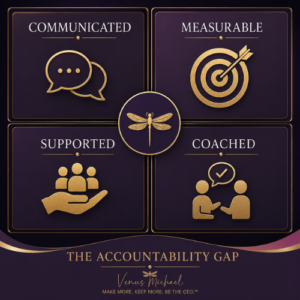
Whenever someone falls short, ask four questions before deciding that the problem is attitude, effort, or performance.
Together, these questions help leaders distinguish between an employee who ignored a clear standard and someone who was never positioned to meet it.
Question One: Was the Expectation Clearly Communicated?
Not implied.
Not assumed.
Communicated.
If you asked three people what success looked like, would they give the same answer?
That is the test.
A vague request might sound like this:
“Please handle this quickly.”
By comparison, a clear request sounds more like:
“Please respond to the client by 3:00 p.m. today, confirm the next step, and copy me only if the issue cannot be resolved within our normal policy.”
The second version reduces interpretation.
It explains the timing, outcome, authority, and escalation point.
Clear communication does not require a long procedure for every task.
Still, it requires enough information for someone to recognize success.
Leaders cannot create accountability around an expectation that exists only in their own minds.
Question Two: Was Success Measurable?
“Do a better job.”
“Be more proactive.”
“Communicate better.”
“Take more ownership.”
These phrases may express a real concern.
Nevertheless, they are not measurable expectations.
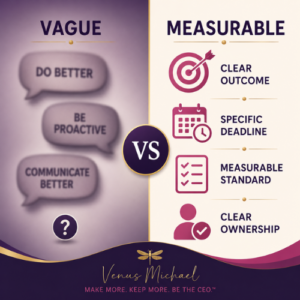
They are opinions.
What does “communicate better” actually mean?
Perhaps it means replying within one business day.
It may mean providing a weekly update.
In another situation, it could mean escalating a risk before the deadline or confirming decisions in writing.
Similarly, what does “take ownership” mean?
Does it mean solving the problem independently?
Should the employee bring two possible solutions?
Are they expected to follow the issue through completion?
Do they need to update everyone affected?
Strong expectations are observable.
People should know what success looks like before the work begins.
In addition, managers should be able to identify whether the standard was met without relying only on personal feelings.
Measurable does not always mean numerical.
It means clear enough to observe.
Question Three: Did They Have What They Needed to Succeed?
Even a clear expectation can fail when the person lacks the tools to meet it.
Consider whether the employee had:
- Training
- Time
- Authority
- Information
- Resources
- Access
- Support
- A realistic workload
Sometimes poor performance is actually poor preparation.
For example, an employee may know what to do but lack the authority to act.
Another person may have the authority but not the training.
Someone else may understand the standard but be carrying three conflicting priorities.
Before labeling the issue as a lack of accountability, examine the environment surrounding the work.
Did leadership remove unnecessary barriers?
Were the priorities clear?
Could the employee make the decisions required?
Did another process make the task harder than necessary?
Accountability includes personal responsibility.
At the same time, leaders are responsible for creating reasonable conditions for success.
Question Four: Did We Coach Before We Corrected?
One conversation rarely changes behavior.
Leadership requires repetition, coaching, feedback, encouragement, correction, practice, and growth.
An employee may understand the expectation intellectually and still need help applying it consistently.
That is where coaching matters.
Instead of waiting until frustration builds, address the issue while it is still small.
First, ask what happened.
Next, clarify the standard.
Then explain the impact.
Listen for confusion or missing information before deciding what the problem means.
Finally, agree on what should happen next time.
This does not mean repeating the same conversation forever.
Rather, it means giving someone a fair opportunity to understand, practice, and improve before concluding that they are unwilling or unable to meet the standard.
Accountability is not a single event.
It is an ongoing leadership relationship.
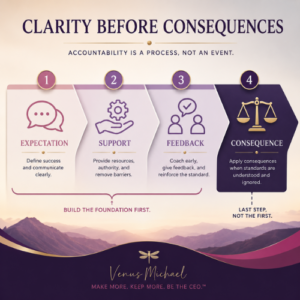
Consequences Should Be the Final Step
Many leaders begin accountability with consequences.
I believe consequences should be the final step, not the first.
Imagine disciplining someone for breaking a rule they never knew existed.
That would not feel like accountability.
It would feel arbitrary.
Effective leadership follows a more thoughtful sequence:
- Define the expectation
- Explain why it matters
- Demonstrate the standard
- Provide resources and authority
- Observe performance
- Give timely feedback
- Coach improvement
- Reinforce the expectation
- Apply consequences when the standard is understood and repeatedly ignored
Consequences still matter.
Without them, standards become optional.
However, consequences are fair only after clarity, support, and feedback have already occurred.
The goal is not punishment.
Instead, the goal is growth, responsibility, and protection of the standard.
Create Accountability Before the Work Begins
Accountability becomes much easier when it begins at the start of an assignment.
Before handing off work, clarify five things.
The Outcome
What needs to be true when the work is complete?
Avoid explaining only the task.
Instead, describe the desired result.
The Owner
Who is responsible for moving the work forward?
Several people may contribute.
However, one person should understand that they own the result.
The Standard
What level of quality, timing, communication, or service is required?
Do not assume everyone defines “good” in the same way.
The Authority
What decisions can the employee make without asking permission?
Accountability without authority creates frustration.
The Checkpoint
When will progress be reviewed?
A checkpoint allows leaders to coach before the deadline rather than correct after failure.
These conversations may take a few extra minutes.
Even so, they can prevent hours of confusion later.
Accountability Starts With Leadership
Here is the uncomfortable part.
Whenever I catch myself saying:
“Why didn’t they do that?”
I have trained myself to ask another question first:
“What did I do, or fail to do, that made this outcome possible?”
Perhaps I assumed they knew.
Maybe I rushed the explanation.
Ownership might have been unclear.
In some cases, I failed to provide enough authority.
I may have skipped the follow-up.
At other times, I avoided a difficult conversation because I hoped the issue would fix itself.
There have also been moments when I allowed the same behavior to continue without addressing it.
Sometimes, however, the answer is no.
The employee may have clearly understood the expectation, had what they needed, received coaching, and still chosen not to meet the standard.
In that case, the employee owns the outcome.
Yet asking myself first makes me a stronger leader.
Leadership is not about finding someone to blame.
It is about creating an environment where success becomes more likely.
Clear Expectations Build Confidence
The third pillar of The Dragonfly Effect™ is Confidence.
Confidence does not come from never making mistakes.
Instead, it comes from knowing what is expected.
When people understand the mission, standards, boundaries, and purpose behind their work, they stop operating from fear.
They no longer need to guess what the leader wants.
As a result, they can focus on the work.
Clear expectations answer important questions:
- What matters most?
- What does success look like?
- What can I decide?
- When should I ask for help?
- How will I know whether I am on track?
- What happens if something changes?
That clarity creates confidence.
In turn, confidence creates ownership.
People are more willing to make decisions when they understand the boundaries surrounding them.
Accountability Is an Act of Respect
I have never believed accountability is about being tough.
Instead, I believe it is about caring enough to tell the truth.
Clear expectations are respectful.
Honest feedback is also respectful.
Explaining the impact of someone’s choices shows respect as well.
Most importantly, giving a person a genuine chance to improve honors their ability to grow.
Leaders who avoid accountability often believe they are being kind.
However, unclear expectations create anxiety.
Avoided conversations create confusion.
Meanwhile, silence encourages people to invent their own explanations.
Someone may believe they are performing well while their manager becomes increasingly frustrated.
Then, weeks or months later, the employee receives a consequence they did not see coming.
That is not kindness.
Real kindness means addressing concerns early enough for someone to respond.
Great leaders do not use clarity to control people.
They use it to help people succeed.
Difficult Conversations Should Not Be Surprises
A performance conversation should rarely be the first time someone hears that a problem exists.
Feedback works best when it is timely.
For example, a missed deadline should be discussed near the missed deadline.
Likewise, a communication problem should be addressed when the pattern first appears.
A quality issue should be reviewed while the work is still fresh.
Waiting creates several problems.
First, the employee may repeat the behavior because no one explained that it needed to change.
Second, the leader’s frustration grows.
Finally, the eventual conversation becomes heavier than necessary.
Early feedback keeps the issue connected to the behavior.
It also gives the employee more opportunity to improve.
Accountability conversations become less dramatic when feedback is part of normal leadership.
The Difference Between a Mistake and a Pattern
Not every mistake deserves a consequence.
People are human.
They misunderstand instructions, overlook details, and make imperfect decisions.
Therefore, a single mistake may require clarification or coaching.
A repeated pattern, however, requires something more.
Leaders should ask:
Was the expectation clear?
Was the person capable of meeting it?
Did they receive feedback?
Did they understand the impact?
Most importantly, did the behavior improve?
When the same issue continues after clarity, support, and coaching, the problem may no longer be confusion.
Instead, it may be unwillingness, poor fit, or a failure to respect the standard.
That is when accountability becomes necessary.
Fair accountability distinguishes between someone who is learning and someone who repeatedly chooses not to meet an understood expectation.
A Simple Accountability Conversation
When a standard is missed, use a clear structure.
Begin with the expectation:
“We agreed that client updates would be sent by Friday afternoon.”
Next, describe what happened:
“The update was not sent, and the client contacted us Monday morning asking for information.”
Then explain the impact:
“That created uncertainty for the client and required someone else to respond without the full context.”
After that, invite perspective:
“Help me understand what happened.”
Once you understand the situation, clarify the next expectation:
“In the future, the update needs to be sent by Friday at 3:00 p.m. If something will prevent that, I need to know by Thursday.”
Finally, confirm ownership:
“Can you commit to that, and do you have what you need to follow through?”
This approach is direct without being demeaning.
It focuses on behavior, impact, and the future.
Most importantly, it removes ambiguity.
Conduct an Accountability Review
Think about one person on your team who is struggling.
Before asking why they are not more accountable, review the leadership environment surrounding the issue.
Have I Clearly Defined Success?
Could the person explain the outcome in specific terms?
Have I Demonstrated the Standard?
Have I shown what strong performance looks like?
Have I Reinforced It?
Has the expectation been repeated through feedback, systems, and leadership behavior?
Have I Coached Toward It?
Did I address the issue early enough for improvement?
Have I Provided Authority and Resources?
Can the person realistically meet the expectation?
Have I Applied the Standard Consistently?
Would another employee receive the same response?
If the answer to these questions is yes, accountability becomes fair.
If the answer is no, leadership still has work to do.
Create Accountability Without Creating Fear
Fear can produce short-term compliance.
However, it rarely produces ownership.
Employees who fear consequences may hide mistakes.
They may also avoid difficult questions.
Some will wait for permission rather than take initiative.
Others may focus more on protecting themselves than solving the problem.
Strong accountability works differently.
Expectations are clear.
Feedback is direct.
Consequences are predictable.
Standards apply consistently.
In addition, people understand that mistakes can become learning opportunities while repeated disregard for expectations will still be addressed.
That balance matters.
Accountability without psychological safety creates silence.
On the other hand, psychological safety without standards creates inconsistency.
Great leadership requires both safety and responsibility.
Venus’ Bottom Line
Accountability does not begin when someone makes a mistake.
It begins the moment expectations are set.
Great leaders do not create accountability through fear.
They build it through clarity, consistency, support, and courageous conversations.
People rarely rise to expectations that were never spoken.
However, they often rise to standards they can clearly understand.
Leadership is not measured only by how quickly you correct mistakes.
It is also measured by how intentionally you help people succeed before those mistakes happen.
So, before asking why someone is not accountable, ask:
Did I give them a fair opportunity to know, understand, and meet the standard?
The answer will tell you whether the next step belongs to the employee, the leader, or both.