A bookkeeping cleanup gets interesting when the problem is no longer, “This expense is in the wrong category.”
Sometimes you open the books and realize the real question is:
What the hell actually happened here?
That was pretty much where I landed with one business owner who summed up the situation better than I could.
“I know enough to be dangerous.”
I did not say it.
She did.
Which, frankly, saved me the trouble.
She was smart. She understood what bookkeeping was supposed to accomplish. Revenue needed to be tracked. Expenses needed to be captured. Owners needed to get paid. Taxes would eventually arrive whether anyone was emotionally prepared for them or not.
The problem was not intelligence.
The problem was mechanics.
At one point in our review, we had owner checks, reimbursements, possible distributions, payroll, contractor payments, and business expenses that had been paid personally and somehow needed to find their way back into the company records.
There was also a pile of checks large enough to make me stop and ask:
“Okay. What are all of these?”
Some went to the owner.
Some paid business expenses.
Some might have been reimbursements.
Other transactions had happened outside the normal process because real businesses have a delightful habit of doing that.
Eventually, I realized we were well past:
“Fix the category.”
This was a bookkeeping cleanup that needed to be pulled apart and put back together.
A Bookkeeping Cleanup Is Financial Reconstruction
When people hear “bookkeeping cleanup,” they often picture someone going into QuickBooks and moving expenses from one category to another.
Sometimes that is exactly what it is.
And sometimes it is archaeology.
A real bookkeeping cleanup can mean reconstructing what actually happened after transactions have been mixed together, recorded inconsistently, duplicated, omitted, or handled outside the normal process.
Before I can decide how something should be categorized, I need to know what it was.
That sounds obvious.
Until you are staring at a check written to the owner.
The bank tells me money left the business.
Wonderful.
Thank you, bank.
Now I have approximately seventeen more questions.
Was the check:
- reimbursement for a business expense the owner paid personally?
- an owner distribution?
- payroll or other compensation?
- repayment of money the owner loaned the company?
- money being moved for a business purchase?
- something else entirely?
Those are not accounting vocabulary differences.
They can create completely different financial results.
The bank statement can tell me that money moved.
It cannot tell me why.
And without the why, I do not have bookkeeping.
I have clues.
Owner Transactions Can Get Messy Fast

Business owners put money into their companies.
They take money out.
Sometimes they pay a business expense on a personal card.
Sometimes the company owes the owner money.
Sometimes the owner owes the company money.
Depending on the entity and tax structure, owners may also receive payroll, distributions, draws, guaranteed payments, or other compensation.
The problem is that those words are not interchangeable just because the money ultimately involves the owner.
But in real life, this is often how the transaction happens:
“I need money. I’ll write myself a check.”
Accounting has follow-up questions.
Or:
“I paid for this software personally, but it was for the business.”
Correct.
Now we have to record the business expense and the fact that the owner funded it.
Or a contractor gets paid outside the usual process because someone needed to get them paid quickly.
The work happened.
The money moved.
Now we need to figure out what happened well enough to record it correctly.
None of this automatically means someone did something terrible.
It means a bookkeeping cleanup cannot be done by guessing.
And guessing is where a small bookkeeping mess starts becoming a large one.
The Dangerous Middle: Knowing Enough to Be Dangerous
There is a level of accounting knowledge every business owner should have.
You should understand your profit and loss statement.
You should understand cash flow.
You should know the difference between revenue and profit.
You should understand why personal and business transactions should stay separate.
Most importantly, you should know which questions to ask.
Where things get interesting is the gap between understanding the goal and understanding every accounting mechanic required to get there.
I understand what a good electrical system is supposed to accomplish too.
That has not inspired me to rewire my house.
The owner in this situation understood that herself.
She knew what she was trying to accomplish.
She also knew she might not have handled every piece of it correctly.
I love that.
Seriously.
I would much rather work with someone who says:
“I did this because I thought it was right, but I’m not completely sure.”
Now we have something to investigate.
The alternative is someone handing me a beautifully organized wrong answer and being emotionally attached to it.
Now we have a negotiation.
Competence is not knowing how to do everything.
Sometimes competence is knowing when you have reached the edge of what you know.
So We Started Reconstructing the Story

Once we stopped looking at the books as a list of categories and started looking at them as a story, the cleanup got clearer.
For every questionable transaction, we kept coming back to the same questions.
What actually happened?
What documentation supports it?
What was the business purpose?
Whose money was it before the transaction?
Whose money was it afterward?
Does the current accounting treatment tell that story correctly?
If not, what needs to change?
That is basically financial forensics for small business.
It is less dramatic than television forensics.
Fewer flashing blue lights.
More PDFs.
But the logic is similar.
You are rebuilding a chain that another reasonable person should be able to follow later.
And “later” matters more than people realize.
Later might be tax time.
Later might be a conversation with a business partner.
Later might be financing.
Later might be selling the company.
Or later might simply be three months from now when you are trying to answer:
“Are we actually profitable?”
That question gets surprisingly difficult when part of what appears to be an expense was really an owner distribution, a reimbursement, or money moving for some completely different reason.
The cleaner the financial story, the better the decision you can make from it.
The Mess Usually Is Not One Giant Mistake
Here is the part I see over and over.
Messy books usually are not created by one spectacular accounting disaster.
They are created by a series of perfectly understandable shortcuts.
The owner pays for something personally.
“We’ll fix it later.”
Someone writes a check.
“We know what that was for.”
A contractor gets paid outside the normal system.
“We’ll document it later.”
Money gets moved.
“I’ll remember why.”
Then six months pass.
And apparently everyone’s memory has entered witness protection.
One shortcut by itself does not look dangerous.
Twenty shortcuts stacked on top of each other become a bookkeeping cleanup.
That is why the work can take much longer than the business owner expects.
You are not simply correcting entries.
You are reconstructing decisions nobody thought they would need to explain again.
A Clean Process Is Cheaper Than a Cleanup
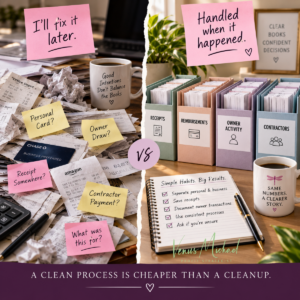
There are a few boring habits that will save you an extraordinary amount of money, time, and irritation.
Keep your business and personal transactions separate.
If you pay a business expense personally, document it when it happens.
When the business reimburses an owner, make it obvious that it is a reimbursement.
Clearly identify owner contributions and distributions.
Keep contractor payments in one trackable process.
Use payroll when payroll is required.
Save receipts and supporting documents when the transaction happens, not eleven months later when everyone has developed a creative interpretation of history.
And if you do not know how an owner transaction should be handled, ask before doing it twenty more times.
That last one is important.
One strange transaction is usually fixable.
Twenty identical strange transactions become a project.
A clean process is almost always cheaper than a bookkeeping cleanup.
But the bigger reason to build those habits is not to make your accountant happy.
It is so your numbers are useful while you can still do something with them.
Your Books Are Supposed to Help You Run the Business
A lot of owners think of bookkeeping as something that exists for tax preparation.
Get the year cleaned up.
Send everything to the CPA.
File the return.
Done.
But if we spend months rebuilding the past just so we can figure out what happened, you have lost one of the most valuable things your financials can give you:
timely information.
The point is not to have beautiful books next April.
The point is to know what is happening now.
Are you profitable?
Are expenses creeping up?
Are owner distributions sustainable?
Is payroll in line with revenue?
Is cash being used the way you think it is?
Can you trust the report sitting in front of you?
That is why bookkeeping cleanup work matters beyond tax compliance.
We are restoring the financial story so you can use it to make decisions again.
Venus’ Bottom Line
A bookkeeping mess is rarely one giant mistake.
It is usually a dozen reasonable shortcuts nobody stopped to define.
A check here.
A personal card there.
A reimbursement nobody labeled.
An owner payment everyone understood at the time.
Until nobody did.
Good bookkeeping preserves the story of the money well enough that you do not have to reconstruct your own business later.
We did eventually put this one back together.
But I would much rather build a process that keeps your future bookkeeper from having to become an archaeologist in the first place.
Because if your financial records require carbon dating, we may have waited too long.
Are Your Books Telling the Whole Story?
If you know your bookkeeping needs attention but you are not sure whether you need a few corrections or a full cleanup, that is a conversation worth having.
We can look at what is happening, what needs to be reconstructed, and whether the bigger opportunity is cleaning up the past or building a better process going forward.