
Great Businesses Don’t Build Better Systems. They Build Better Decisions.
Business systems are not important simply because they make work faster.
Their real value is that they help people make better decisions without forcing the owner to personally answer every question, approve every exception, or solve the same problem repeatedly.
If you have ever worked with me, you have probably heard me say something that surprises people.
“I don’t actually love systems.”
People usually look at me like I just admitted accountants do not like spreadsheets.
Of course, I believe businesses need systems.
But I think we have been talking about them all wrong.
Most entrepreneurs believe systems exist to create efficiency.
To save time.
To organize work.
To eliminate mistakes.
Those are valuable outcomes.
But they are not the real reason systems matter.
The real purpose of a system is much more important.
A great system helps ordinary people make extraordinary decisions consistently.
That is what changes a business.
Why Are Business Systems Important?
Business systems are important because they remove uncertainty.
When people do not know what to do, they hesitate.
They guess.
They react.
They create inconsistency.
A well-designed system does more than tell someone how to complete a task.
It helps them understand how to think when they encounter a decision.
That is the difference between a checklist and a business that can scale.
A checklist says:
“Complete these steps.”
A strong system also explains:
“This is what matters.”
“This is the standard.”
“This is how we decide.”
“This is when you move forward.”
“This is when you ask for help.”
That context creates better judgment.
And better judgment creates a stronger business.
Business Systems Reduce Decision Fatigue
Entrepreneurs make hundreds of decisions every day.
Should I discount this proposal?
Can I hire another employee?
Should I respond to this client tonight?
Do we need another software platform?
Can we afford this investment?
Should I raise my prices?
Should I keep this difficult client?
Most of these decisions are not difficult because they are unusually complicated.
They are difficult because there is no framework guiding them.
Every time you make the same decision from scratch, you use energy that could have been spent solving a more important problem.
Eventually, the business keeps moving.
But the owner’s thinking begins to slow down.
The most successful businesses do not eliminate decisions.
They eliminate unnecessary decision-making.
Strong business systems prevent routine questions from consuming leadership attention over and over again.
Business Systems Replace Repeated Uncertainty
Think about the questions that come back to you every week.
Can I approve this purchase?
Should we offer a discount?
How quickly should I respond?
Can I make an exception?
What should I say to this client?
Do you want me to move forward?
If the same question keeps appearing, the problem may not be the employee asking it.
The business may not have defined how that decision should be made.
That is an important distinction.
A team cannot make consistent decisions from unclear expectations.
And an owner cannot scale while remaining the answer to every recurring question.
The strongest business systems turn repeated uncertainty into repeatable judgment.
The Decision Filter
One of the most valuable systems any company can build is what I call The Decision Filter.

Before making a significant decision, run it through four questions.
The purpose is not to make every choice slow or bureaucratic.
The purpose is to create consistency.
When everyone understands the same questions, decisions become less dependent on mood, memory, urgency, or whoever happens to be in the room.
Question One: Does This Align With Where We Are Going?
Not where we have been.
Not what our competitors are doing.
Where we are going.
A business without direction says yes to almost everything.
A business with clarity says yes only to what moves the mission forward.
This question helps prevent attractive distractions from becoming expensive commitments.
A new opportunity may create revenue.
But does it support the business model you are intentionally building?
A client may be ready to hire you.
But are they the kind of client you want more of?
A new service may sound exciting.
But does it strengthen your positioning or create more complexity?
Alignment gives a decision context.
Without it, almost every opportunity can appear worthwhile.
Strong business systems help the team evaluate choices against the future, not simply the pressure of the moment.
Question Two: Does This Strengthen or Weaken the Business?
Some decisions create short-term relief and long-term pain.
Others create short-term discomfort and long-term strength.
Great leaders learn to recognize the difference.
Hiring the wrong person because you are overwhelmed may solve today’s problem.
It may create next year’s.
Discounting a proposal may close the sale quickly.
It may also weaken your pricing, margins, and future expectations.
Avoiding a difficult conversation may keep the day peaceful.
It may quietly teach the team that standards are optional.
Before choosing the easiest immediate solution, ask:
Will this make the business stronger after the immediate pressure is gone?
A strong system does not optimize only for speed.
It protects the long-term health of the company.
Question Three: Would I Want This to Become Our Normal?
This question has saved me countless times.
Because every exception eventually risks becoming a precedent.
You answer client emails at midnight once.
Soon, they expect it.
You discount your pricing once.
Soon, it becomes part of your reputation.
You allow one broken process to continue.
Soon, everyone assumes that is how things work.
Ask yourself:
If we repeated this decision 100 times, would we have a stronger business?
That question changes the way you evaluate exceptions.
One exception may feel harmless.
Repeated behavior becomes culture.
Repeated discounts become a pricing model.
Repeated rescues become dependency.
Repeated urgency becomes the operating system.
Good business systems help leaders recognize that every decision teaches the organization what “normal” looks like.
Question Four: Can This Decision Happen Without Me Next Time?
This is where businesses begin to scale.
If every decision requires the owner, the owner becomes the bottleneck.

Systems are not about removing people.
They are about removing unnecessary dependency.
Ask:
What information would someone need to make this decision?
What authority would they need?
What standard should guide them?
What dollar threshold should trigger approval?
What circumstances should create an exception?
What should happen when the answer is unclear?
The goal is not for your team to make every decision perfectly.
The goal is for them to make good decisions consistently.
A business does not scale when the owner becomes faster at answering questions.
It scales when fewer routine questions need the owner at all.
Business Systems Help Companies Make Fewer Routine Decisions
This may sound backward.
But it is true.
The healthiest companies I have worked with do not have leaders making more decisions.
They have leaders making fewer routine decisions.
That is because the recurring ones have already been systemized.
Pricing guidelines.
Hiring processes.
Client onboarding.
Communication standards.
Approval thresholds.
Financial reviews.
Customer service expectations.
Expense policies.
Instead of asking:
“What should we do?”
The team already understands:
“This is how we make decisions here.”
That is culture.
Not bureaucracy.
Bureaucracy adds steps without adding value.
Strong business systems create clarity so people can move forward with confidence.
Business Systems Create Confidence
One of the unexpected benefits of good systems is confidence.
Think about your newest employee.
On their first day, they are uncertain.
Not because they are incapable.
Because they do not yet understand how decisions are made.
They do not know what the company values most.
They do not know which details matter.
They do not know how much authority they have.
They do not know what requires approval.
As expectations and systems become clearer, confidence grows.
The same thing happens for business owners.
The more intentional your systems become, the less you are forced to rely on memory, emotion, or guesswork.
Confidence is not created by knowing everything.
It is created by reducing unnecessary uncertainty.
That is why business systems are not only operational tools.
They are confidence-building tools.
Business Systems Go Beyond Checklists
A checklist can tell someone what to do in a familiar situation.
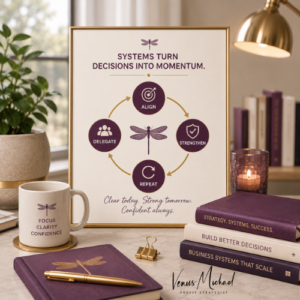
A decision system helps them think when the situation changes.
That difference matters because no process can anticipate every possible circumstance.
Clients ask unusual questions.
Employees encounter exceptions.
Technology changes.
Markets shift.
Priorities evolve.
A business cannot write a detailed procedure for every future moment.
But it can teach principles.
For example:
Protect profitability.
Communicate early.
Do not surprise the client.
Escalate legal or financial risk.
Respect approval thresholds.
Choose the option that supports the long-term relationship.
Protect the company’s reputation.
These principles help people make thoughtful choices even when the checklist no longer fits perfectly.
Procedures create consistency in predictable situations.
Principles create consistency when the situation is new.
The strongest business systems include both.
The Dragonfly Effect™
One of the four pillars of The Dragonfly Effect™ is Control.
People often misunderstand that word.
Control does not mean controlling every person or every outcome.
It means creating systems that produce consistency.
Consistency creates trust.
Trust creates confidence.
Confidence creates capacity.
That is why I believe systems are not about becoming more organized.
They are about becoming more intentional.
Every great business is simply a collection of intentional decisions repeated consistently.
When the decision-making process is clear, the business no longer depends on one person remembering everything.
It begins operating from shared standards.
That is real control.
Build Business Systems That Do Not Depend on Memory
Here is a question I ask clients from time to time:
“If you disappeared for a month, would your team know how to make good decisions?”
Not perfect decisions.
Good decisions.
Because that is the goal.
The goal is not to build a business where everyone waits for the owner.
It is to build a business where people understand the principles well enough to move forward with confidence.
If the company depends on what you remember, what you notice, what you approve, and what you personally explain, the business remains fragile.
Memory is not a system.
Availability is not a system.
Heroic effort is not a system.
A resilient business does not require the owner to carry every answer in their head.
It creates a shared way of thinking.
That is leadership.
Review the Decisions That Keep Returning to You
Choose one decision you make repeatedly.
Maybe it is:
- Approving expenses
- Responding to leads
- Handling customer complaints
- Scheduling meetings
- Offering discounts
- Hiring
- Approving proposals
- Managing client exceptions
Now ask:
Why does this still require me?
Is there no clear standard?
Is the team missing information?
Do they lack authority?
Have I never documented the process?
Do I step in too quickly?
Have I trained people to wait for my answer?
Then ask one more question:
What business system could eliminate the need for me to make this decision every single time?
Do not build a bigger to-do list.
Build a better way of thinking.
Your future team will thank you.
So will your future self.
Venus’ Bottom Line
Most entrepreneurs believe systems are about efficiency.
I believe they are about freedom.
Every decision your business can make without depending on you creates room for something only you can do.
That is how businesses grow.
Not by asking the owner to carry more.
But by building business systems that help everyone make better decisions.
The strongest businesses are not built on heroic effort.
They are built on intentional systems that make excellence repeatable.
So look at the questions that keep coming back to you.
Are they proof that your team needs more answers?
Or evidence that your business needs a better way to decide?

