Your Calendar Is a Financial Statement
CEO time management is not simply about fitting more work into your week.
It is about deciding which work deserves access to your most limited resource.
A few months ago, I asked a client a question that completely caught her off guard.
I did not ask to see her Profit and Loss statement.
I did not ask about revenue.
I did not ask about cash flow.
Instead, I said:
“Can I see your calendar?”
She looked confused.
“My calendar?”
“Yes.”
A few minutes later, she pulled it up.
As we scrolled through the week together, I noticed something immediately.
Her calendar was full.
Every hour was spoken for.
Client meetings.
Team meetings.
Phone calls.
Emails.
Administrative work.
Networking events.
Then more client meetings.
There was not a single block of time dedicated to planning.
No time for strategy.
No CEO time.
No thinking time.
Just reacting.
When we finished scrolling, I smiled and said:
“I can already tell you why your business feels overwhelming.”
It was not because of her financial statements.
It was because of her calendar.
How Should CEOs Spend Their Time?
The best CEOs understand that time is their most valuable investment.
Effective CEO time management means protecting time for strategy, leadership, planning, decision-making, key relationships, and work that strengthens the business’s future.
Every hour on your calendar is a business decision.
You are investing your most limited resource in something.
The question is not whether you are busy.
The question is whether your time is producing the return your business needs.
Long before financial problems appear on your Profit and Loss statement, they often begin appearing on your calendar.
Your Calendar Reveals Your Real Priorities
Business owners tell me what matters to them all the time.
“I want to grow.”
“I want to work less.”
“I want to become more strategic.”
“I want better systems.”
“I want to delegate.”
Then we look at their calendars.
There is not a single hour reserved for improving systems.
No time for leadership.
No time for training.
No time for strategic planning.
No time to review financial reports.
Only urgent work.
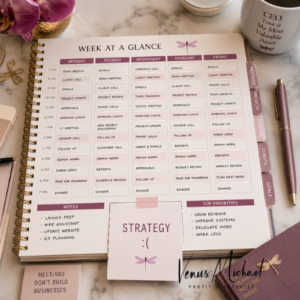
Your calendar tells the truth your goals sometimes hide.
Every appointment is a vote for the kind of business you are creating.
You may say that strategy matters.
Does strategy appear on your calendar?
You may say you want your team to become more independent.
Have you reserved time to train and develop them?
You may say you want better financial results.
Is there time set aside to review the numbers and make decisions from them?
Intentions matter.
However, repeated behavior usually matters more.
CEO Time Management Begins With Investment
Most entrepreneurs think money is their first investment.
It is not.
Time is.
Before your business ever earns a dollar, you have already invested your attention.
Your creativity.
Your energy.
Your relationships.
Your focus.
Unlike money, time cannot be earned again later.
Once an hour is spent, it is gone.
That does not mean every hour must produce immediate revenue.
Some of the most valuable work a CEO performs will not generate a dollar today.
Developing a leader may create value for years.
Improving a process may prevent hundreds of future problems.
Reviewing financial trends may reveal a decision that protects the company six months from now.
Thinking does not always create an immediate transaction.
It still creates value.
That is why strong CEO time management requires more than measuring how much you completed.
You must consider what your time made possible.
The Time ROI Matrix
One exercise I encourage business owners to use is something I call The Time ROI Matrix.
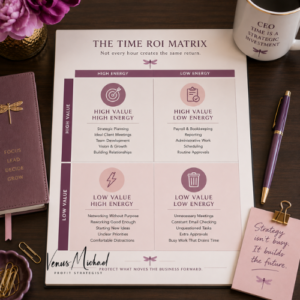
At the end of each week, review everything on your calendar.
Then place each activity into one of four categories.
The goal is not to judge every hour harshly.
The goal is to identify where your time creates value, where it drains value, and where another person or system could eventually take ownership.
High Value and High Energy
These are the activities you should protect.
They create meaningful value and use your strongest abilities.
Examples may include:
- Strategic planning
- Meeting with ideal clients
- Developing your team
- Creating intellectual property
- Building important relationships
- Reviewing major financial decisions
- Setting direction
- Vision work
These activities move the business forward.
They often represent work that only you can do, especially at the current stage of the company.
Unfortunately, this work is often the first thing removed when the calendar becomes crowded.
Strategy gets postponed because a client wants a meeting.
Planning gets delayed because the inbox is full.
Leadership development gets skipped because completing the task yourself feels faster.
That creates a dangerous pattern.
The work that builds the future keeps losing to the work that manages today.
Protecting high-value, high-energy work is one of the most important parts of CEO time management.
Do not wait to see whether time remains.
Schedule it first.
High Value and Low Energy
These activities are important.
However, they may not need to depend on you forever.
Examples may include:
- Payroll
- Bookkeeping
- Administrative work
- Routine reporting
- Scheduling
- Recurring approvals
- Standard client communication
The work matters.
The question is whether the CEO must continue owning it.
This category often reveals the best opportunities for systems, automation, training, or delegation.
Do not immediately hand everything to someone else.
First, determine why it still depends on you.
Is there no documented process?
Does the team lack authority?
Are expectations unclear?
Have you continued doing it because it feels easier than teaching someone?
Delegation without clarity creates confusion.
However, keeping every important task because it matters creates dependency.
The goal is not to abandon valuable work.
The goal is to build a business where valuable work happens consistently without requiring your personal involvement every time.
Low Value and High Energy
These activities can be deceptive.
They feel productive.
They may be enjoyable.
They may even be exciting.
But you must ask whether they are moving the business forward.
Examples could include:
- Networking without a clear purpose
- Creating content that does not support a strategy
- Reworking something already good enough
- Attending events because you are afraid of missing out
- Starting new ideas before completing existing priorities
- Involving yourself in work your team can handle
Sometimes these activities create value.
Sometimes they are comfortable distractions.
They allow you to feel active without confronting a more important decision.
That may be why a business owner spends two hours perfecting a presentation but avoids reviewing declining margins.
It may be why someone attends another networking event instead of having the difficult conversation their team needs.
Motion can feel safer than leadership.
The calendar cannot tell you why an activity is there.
But it can help you notice the pattern.
Low Value and Low Energy
This is where businesses quietly lose momentum.
Examples include:
- Meetings without a purpose
- Software you rarely use
- Constant email checking
- Unnecessary approvals
- Repetitive status updates
- Tasks no one has questioned
- Conversations that should have been an email
- Work that exists only because it has always existed
These activities consume time without creating enough value to justify it.
Fortunately, they are often the easiest place to create immediate capacity.
You may not need another employee.
You may need fewer unnecessary meetings.
You may not need another productivity tool.
You may need to stop checking three platforms every hour.
You may not need to work faster.
You may need to remove work that never should have existed.
Elimination is one of the most overlooked tools in CEO time management.
Your Business Grows Where Your Attention Goes
Businesses do not usually become healthier because their owners suddenly find more time.
They become healthier because their owners protect the right time.
The strongest CEOs I know schedule strategy before they schedule meetings.
They protect thinking time.
Reflection time.
Planning time.
Decision time.
They understand something operators often forget.
Thinking is work.
In fact, it may be some of the highest-value work a CEO can do.
That does not mean sitting in an office pretending to think while avoiding action.
It means creating enough space to ask better questions.
What has changed?
What are we not seeing?
Where are we becoming too dependent on one person?
Which part of the business is getting weaker while revenue still looks healthy?
What opportunity should we decline?
What decision are we postponing?
Urgent work rarely gives you room to ask those questions.
You must create that room intentionally.
Busy Is Not the Same as Productive
We have confused movement with progress.
Answering 50 emails feels productive.
Attending six meetings feels productive.
Checking tasks off a list feels productive.
But none of those activities guarantee progress.
Progress happens when today’s work creates a better tomorrow.
That may mean completing a task.
It may also mean removing a task permanently.
It may mean solving a client problem.
It may also mean building a system that prevents the problem from returning.
It may mean answering a team member’s question.
It may also mean coaching them so they can answer it themselves next time.
Activity measures what you did.
Leadership considers what your actions changed.
That is an essential distinction in CEO time management.
If Someone Looked at Your Calendar, Would They Know You Are the CEO?
Imagine handing your calendar to someone who had never met you.
Would they know you are the CEO?
Or would they assume you are the administrative assistant?

Would they see time spent building the future?
Or only managing the present?
Would they see leadership?
Planning?
Financial review?
Relationship building?
Team development?
Or would they see an entire week spent reacting to everyone else’s priorities?
Your calendar answers that question more honestly than your job title ever will.
This does not mean CEOs are above administrative work.
Every business has seasons when the owner must step in.
The problem begins when stepping in becomes the permanent operating model.
A temporary responsibility can be necessary.
A permanent dependency becomes a ceiling.
Review Your Calendar Like a Financial Statement
Most business owners review their financial statements to see where money went.
You can review your calendar the same way.
Treat every block of time like an expense.
Ask:
- What return did this create?
- Did this require me?
- Did this move the business forward?
- Should this happen again?
- Could a system eliminate it?
- Could someone else eventually own it?
- What did I give up by making time for it?
This is where the calendar connects directly to the previous episode’s Cost of Yes Framework.
Every time you accepted a meeting, project, event, or responsibility, something else lost access to that time.
Your calendar is the accumulated evidence of those yeses.
It shows what won.
It also shows what kept losing.
A Practical CEO Time Management Review
Open your calendar for this week.
Not next month.
Not next year.
This week.
Review every meeting and block of work.
Then ask three questions.
What created the greatest return?
Think beyond immediate revenue.
What improved the future of the business?
What strengthened a relationship?
What clarified a decision?
What developed another leader?
What prevented a future problem?
What could someone else eventually own?
Do not ask only whether someone else can complete the task.
Ask what they would need to own the outcome.
Training?
Clear expectations?
Authority?
A documented process?
Practice?
Your calendar may reveal your next delegation opportunity.
What should never have been on my calendar?
This is the uncomfortable one.
Which meeting did not need to happen?
Which task existed only from habit?
Which request did you accept without asking whether it supported your priorities?
Which hour disappeared because you were reacting instead of choosing?
Do not judge yourself.
Observe.
Awareness always comes before improvement.
Venus’ Bottom Line
Money follows decisions.
Decisions follow priorities.
And priorities are revealed by how you spend your time.
If you want to know where your business will be a year from now, do not review only your financial statements.
Review your calendar.
Your calendar is not simply recording your week.
It is predicting your future.
The businesses that scale are not built by CEOs who work the most hours.
They are built by CEOs who invest their hours with intention.
So look at your calendar.
Is it building the future you keep saying you want?