The Best CEOs Make Fewer Decisions
To avoid decision fatigue, CEOs must stop treating every question as if it deserves their personal attention.
The goal is not to become better at answering everything.
Instead, the goal is to build a business where routine decisions happen consistently without waiting for the owner.
When people imagine successful CEOs, they often picture someone making hundreds of important decisions every day.
They picture the CEO handling every meeting, email, hire, client, problem, opportunity, and dollar.
The assumption is simple.
As the business grows, the CEO must make more decisions.
However, after working with business owners for years, I have come to believe the exact opposite.
The best CEOs do not make more decisions.
They eliminate the need to make them.
That is one of the biggest shifts from being an operator to becoming a leader.
How Do CEOs Avoid Decision Fatigue?
CEOs avoid decision fatigue by reducing the number of routine choices that require their involvement.
First, they automate predictable actions.
Next, they systemize recurring decisions.
Then, they delegate authority to capable people.
Finally, they protect their best thinking for vision, culture, strategy, major investments, key hires, and the future of the business.
Every decision consumes something valuable.
Time is only part of the cost.
Decisions also require mental energy, focus, creativity, patience, and willpower.
Unfortunately, those resources are limited.
Therefore, the more energy you spend deciding what does not matter, the less you have available for what does.
Decision Fatigue Is Real
Have you ever reached the end of the day and found yourself staring at your computer?
You know the decision should be simple.
Yet you cannot seem to make it.
Perhaps you cannot decide what to work on next.
Maybe you keep rereading the same email.
Meanwhile, someone is waiting for you to approve an expense.
The decision itself may not be difficult.
Your brain is simply tired.
Business owners experience this constantly.
Questions land on their desks all day.
Approvals wait for their attention.
Exceptions interrupt their concentration.
In addition, every small uncertainty creates another demand on their thinking.
Eventually, the business does not slow down.
The owner’s thinking does.
For that reason, learning to avoid decision fatigue is not merely a productivity exercise.
It is a leadership responsibility.
Every Unnecessary Decision Has a Cost
Imagine that every decision costs $10.

Would you still approve every office supply purchase?
Would you personally answer every routine client question?
Would you decide which meeting room the team should use?
Would every minor exception still require your approval?
Probably not.
Instead, you would immediately ask:
“Why does this require my involvement?”
Of course, the actual cost is not $10.
It is much higher.
Every unnecessary decision consumes attention that could have been used on a decision only you can make.
For example, a pricing question steals attention from strategy.
A minor approval interrupts financial planning.
Likewise, a routine client issue can break the concentration needed for a major hire.
An avoidable meeting may push vision work into another week.
The cost is not limited to the minutes required to answer.
It also includes the attention lost before and after the interruption.
Strong leaders avoid decision fatigue by treating attention as a limited business asset.
The CEO Decision Pyramid
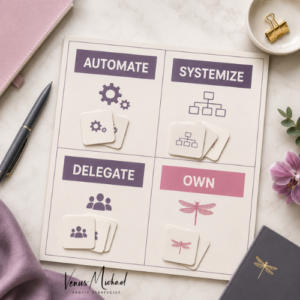
One framework I teach is The CEO Decision Pyramid.
It helps leaders determine where a decision belongs and whether it should continue requiring the CEO.
The pyramid has four levels:
- Automate it
- Systemize it
- Delegate it
- Own it
As decisions move lower in the pyramid, they should require less personal involvement from the CEO.
Meanwhile, decisions at the top deserve the leader’s strongest attention.
Level One: Automate It
When technology can perform something consistently, let technology do it.
Common examples include:
- Recurring invoices
- Appointment reminders
- Payment reminders
- Standard reports
- Routine email confirmations
- Scheduling links
- Data transfers
- Repetitive notifications
Automation does not mean removing the human element from every interaction.
Instead, it protects people from work that does not require human judgment.
A reminder does not need creativity.
Likewise, a recurring invoice does not need leadership.
A standard confirmation does not require the CEO.
Therefore, when technology can perform the task reliably, assigning it to a person creates unnecessary work and unnecessary decisions.
Automation helps CEOs avoid decision fatigue by removing small, predictable choices before they reach the calendar.
Level Two: Systemize It
When a decision occurs repeatedly, create a process for it.
Examples include:
- Client onboarding
- Proposal approvals
- Expense policies
- Refund requests
- Meeting agendas
- Pricing guidelines
- Communication standards
- Financial reviews
- Hiring steps
- Customer complaints
However, a strong system should do more than list steps.
It should clarify:
- What matters
- What the standard is
- Who owns the decision
- What authority they have
- When approval is required
- What creates an exception
- When the issue should be escalated
The fewer routine decisions your business makes from scratch, the stronger the company becomes.
A system turns past thinking into future consistency.
As a result, the team can respond without recreating the answer every time.
That is how business systems help CEOs avoid decision fatigue without lowering standards.
Level Three: Delegate It
Not every decision belongs to the owner.
Great leaders do not simply create followers.
They create decision-makers.
When someone on your team understands your values, expectations, systems, and priorities, give them room to use that knowledge.
Delegation is not assigning a task while keeping every decision.
That is only task transfer.
True delegation includes enough context, authority, and ownership for another person to move the work forward.
For instance, do not merely say:
“Handle client issues.”
Instead, clarify:
- What outcome matters
- What authority they have
- What financial limit applies
- Which situations require escalation
- What standard protects the relationship
- What must be documented
Delegation does not remove the CEO’s responsibility for the business.
However, it does reduce the company’s unnecessary dependence on the CEO.
That is how leadership multiplies.
Level Four: Own It
This is where the CEO belongs.
Some decisions deserve your best thinking.
They should not be automated, reduced to a rigid checklist, or casually handed away.
Examples include:
- Vision
- Culture
- Strategy
- Major investments
- Key hires
- Critical relationships
- Business model changes
- Significant financial commitments
- Risk
- Long-term direction
- The future of the company
These decisions affect the entire organization.
In many cases, they also require context that does not exist anywhere else in the business.
Most importantly, they deserve mental space.
For example, a CEO who spends the morning approving small purchases may have less patience for a serious team issue that afternoon.
Similarly, a constantly interrupted CEO may never reach the focused state required for long-range thinking.
The purpose of the lower levels is to protect the top.
Therefore, CEOs avoid decision fatigue by preserving their strongest attention for the decisions that shape the business.
Stop Becoming the Bottleneck
One question I ask clients from time to time is:
“If your team had to wait for you to answer every question tomorrow, what would stop?”
The answer usually surprises them.
Almost everything.

That does not always mean the team is incapable.
More often, the business has unintentionally trained everyone to wait.
Perhaps the owner answers too quickly.
Maybe the team has responsibility without authority.
In other cases, approval limits were never defined.
Exceptions may also be handled differently each time.
Sometimes employees are criticized for making the wrong decision but are never taught how to make a better one.
An owner may say they want initiative while continuing to override every choice.
Over time, waiting becomes the safest behavior.
Consequently, the team stops deciding.
The owner becomes more overwhelmed.
Meanwhile, the business becomes slower.
Healthy companies do not operate through constant permission.
Instead, they operate within principles, systems, standards, and clear authority.
A Bottleneck Is Often Trained
Owners sometimes say:
“My team will not make decisions.”
Before blaming the team, however, look at the environment.
What happens when someone makes a decision differently from the way you would have made it?
Do you coach them, or do you immediately take the work back?
Do you explain the principle, or do you only correct the outcome?
Have you given them clear authority?
Or have you told them to own the decision while still requiring approval?
Team members also need to know which mistakes are acceptable.
Otherwise, every error feels dangerous.
People become confident decision-makers through practice.
Yet that practice requires room.
If every decision is corrected, overridden, or reclaimed, the team learns that waiting is safer than thinking.
Leaders who want to avoid decision fatigue must stop unintentionally rewarding dependency.
Capacity Is Not Only Created by Hiring
The final pillar of The Dragonfly Effect™ is Capacity.
Most entrepreneurs assume capacity comes from hiring more people.
Sometimes it does.
However, capacity can also come from eliminating unnecessary work.
That includes unnecessary meetings, approvals, reports, handoffs, interruptions, and decisions.
When those demands disappear, you do not simply create more time.
You create space.
That space allows you to think, lead, innovate, and develop other people.
It also gives you room to build the business you have been too busy maintaining.
Adding another employee to a decision-heavy business may not solve the problem.
Instead, it may create another person who needs the owner’s answers.
Therefore, before increasing headcount, reduce unnecessary dependency.
Your Business Should Become Easier to Lead
Here is something I wish more entrepreneurs believed.
As your business grows, it should not become more dependent on you.
It should become less dependent on you.
That is the goal.
This does not mean you care less.
It means you have built something stronger.
Over time, a growing business should develop:
- Clearer systems
- Stronger leaders
- Better information
- Defined authority
- Repeatable standards
- More confident employees
- Fewer owner-dependent decisions
The strongest businesses do not grow because the owner carries increasingly more.
They grow because the business becomes increasingly capable.
That does not make the CEO unnecessary.
Instead, it makes the CEO available for higher-value leadership.
Reduce Decisions Before Adding Productivity Tools
When owners feel overwhelmed, they often search for a new productivity tool.
They try another task manager.
Then they add another communication platform.
Next comes another calendar system or dashboard.
Those tools may help.
However, technology cannot solve a decision problem that has never been clarified.
Before adding another platform, ask:
- Why does this decision exist?
- Why does it repeat?
- Why does it require me?
- Can it be eliminated?
- Can it be automated?
- Can a system guide it?
- Can someone else own it?
- Does it belong to the CEO at all?
You may not need to organize more decisions.
You may need fewer decisions.
That is the central shift required to avoid decision fatigue.
Conduct a One-Day Decision Audit
Tomorrow morning, keep a simple tally.
Each time someone asks you a question, make a mark.
Do the same for every approval, interruption, exception, and decision.
For now, do not change anything.
Observe.
At the end of the day, review the total.
Then, classify each decision using the CEO Decision Pyramid.
What Could Be Automated?
Look for predictable actions with clear triggers.
These may include reminders, confirmations, recurring billing, standard reports, and scheduling.
What Could Be Systemized?
Next, look for decisions that keep returning in similar forms.
Examples may include approvals, client requests, pricing questions, onboarding steps, and communication expectations.
What Could Be Delegated?
Then identify decisions that require human judgment but do not necessarily require yours.
Team scheduling, routine customer service, project decisions, standard spending, and vendor coordination may belong here.
What Must You Continue to Own?
Finally, protect the decisions involving:
- Vision
- Culture
- Strategy
- Major risk
- Significant financial commitments
- Key people
- Long-term direction
This one-day audit may reveal one of the greatest opportunities in your business.
It may not be another marketing strategy.
It may not be another software platform.
Instead, it may be a better way of leading.
Do Not Eliminate Thinking
Making fewer decisions does not mean avoiding responsibility.
It also does not mean becoming disconnected.
Likewise, it does not mean delegating decisions you do not want to face.
The goal is not to eliminate thinking.
The goal is to eliminate unnecessary thinking so the right decisions receive enough of it.
Automation should handle what is predictable.
Systems should guide what repeats.
Delegation should distribute what others can own.
Meanwhile, the CEO should remain deeply engaged with what shapes the company’s future.
That is not avoidance.
It is discipline.
Venus’ Bottom Line
Great CEOs are not valuable because they make every decision.
They are valuable because they protect their thinking for the decisions that matter most.
The goal is not to become busier as the business grows.
The goal is to become clearer.
Clarity creates better decisions.
In turn, better decisions create stronger systems.
Stronger systems create confident teams.
Ultimately, confident teams create the capacity entrepreneurs spend years searching for.
Leadership is not about carrying the business on your shoulders forever.
It is about building a business that can stand on its own.
So look at the decisions waiting for you today.
Which ones truly need a CEO?
And which ones are proof that the business needs a better way to operate?