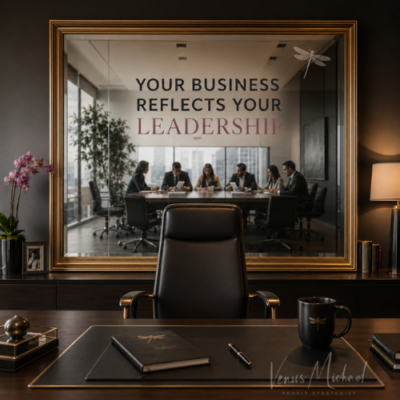
Your Business Is a Mirror
Recurring business problems rarely happen by accident.
When the same issues appear with different employees, different clients, different systems, and different years, the common denominator may be the leadership environment surrounding them.
A business owner once sat across from me and spent nearly an hour explaining everything that was wrong with her team.
“They don’t communicate.”
“They don’t take ownership.”
“They wait for me to tell them what to do.”
“They don’t think ahead.”
“They don’t lead.”
Eventually, she stopped talking and asked the question she really wanted answered.
“How do I fix my employees?”
I sat quietly for a moment.
Then I asked a question that changed the entire conversation.
“Can I ask you something that is probably going to make you uncomfortable?”
She smiled.
“I hired you because I figured you would.”
So I asked:
“Where do you think they learned that?”
The room went silent.
Not because she did not know the answer.
Somewhere deep down, she already did.
From that moment forward, we stopped talking about fixing employees.
Instead, we started talking about leadership.
Businesses have a remarkable way of becoming mirrors.
Over time, they reflect the beliefs, behaviors, expectations, and standards of the people leading them.
Once you recognize that, the entire conversation changes.
Why Does My Business Keep Having the Same Problems?
Businesses experience recurring business problems because they repeat the behaviors that leadership consistently models, tolerates, rewards, and rescues.
When the same issue continues appearing with different people, the problem may not be the individuals involved.
It may be the environment they are entering.
Perhaps employees wait for instructions because leaders always provide the answer.
Maybe people avoid difficult conversations because leadership avoids them too.
The team may resist accountability because poor performance rarely creates a meaningful consequence.
Alternatively, employees may hesitate to act because their decisions are frequently overridden.
That is not meant to create guilt.
It is meant to create possibility.
If leadership helped create the pattern, leadership can also change it.
Your Business Is Always Telling Your Leadership Story
You can learn a surprising amount about a business without ever meeting its owner.
Walk through the office.
Listen to the conversations.
Watch how people respond to problems.
Notice how decisions are made.
Then pay attention to what happens when something goes wrong.
Do employees solve problems, or do they wait for permission?
Do mistakes become learning opportunities, or do they become blame sessions?
Does the team protect the customer, or does everyone protect themselves?
Are decisions made confidently, or does every question travel back to the owner?
These are not simply employee habits.

They are leadership fingerprints.
Every organization develops an identity.
The important question is whether that identity developed intentionally or accidentally.
Culture Is Not What You Say It Is
Many companies proudly display their values on a wall.
Integrity.
Excellence.
Teamwork.
Innovation.
There is nothing wrong with putting values into words.
However, words alone do not create culture.
Behavior does.
Culture is not your mission statement.
It is not the employee handbook.
Nor is it the speech delivered during orientation.
Culture is what people do when no one is watching.
It appears when a customer complains.
You can see it in how the team responds when the owner is away.
It becomes visible through the standard people choose when no one checks their work.
Culture is not announced.
It is repeated.
Therefore, leaders cannot evaluate culture only by asking what the company claims to value.
They must examine which behaviors the business repeatedly accepts.
The Leadership Mirror
One way I think about recurring business problems is through a framework I call The Leadership Mirror.
A mirror does not criticize.
It reflects.
When leaders avoid difficult conversations, the team learns to avoid them.
If leaders constantly rescue people, employees stop solving problems independently.
When leaders panic under pressure, anxiety spreads through the organization.
If leaders tolerate mediocre work, mediocrity eventually becomes the standard.
The mirror is not judging anyone.
Instead, it is showing what has been repeated often enough to become normal.
That is why changing a business often begins with changing the leader.
The team may need new expectations.
Processes may need improvement.
Roles may need clarification.
Still, none of those changes will last if leadership continues reinforcing the old pattern.
The Hardest Leadership Lesson I Learned
There was a season in my own business when I found myself asking the same questions repeatedly.
Why does everyone keep asking me?
Why does no one take initiative?
Why do I have to be involved in everything?
At first, I assumed I had a team problem.
Eventually, I recognized something difficult to admit.
I had unintentionally trained people to depend on me.
Whenever I jumped in with the answer, I taught them not to search for one.
Each time I solved a problem instead of coaching someone through it, I reinforced the idea that leadership belonged to me alone.
Although I wanted independent thinkers, my behavior rewarded dependency.
As a result, I was building a business that could not function without me.
That was not simply their failure.
It was also my leadership pattern.
Once I saw it clearly, I could no longer blame the outcome without examining my contribution to it.
Leaders Teach People How to Behave
People do not become part of your culture because they read your policies.
They become part of it because they observe your patterns.
Suppose you tell your team that work-life balance matters.
Then you send emails at midnight and expect immediate replies.
Your behavior wins.
Perhaps you say quality matters.
However, you repeatedly accept work that fails to meet the standard.
Again, your behavior wins.
You may encourage independent decision-making.
Yet every time someone makes a different choice, you override it without explaining why.
Soon, people stop choosing.
Employees do not simply rise to expectations.
They adapt to examples, consequences, and repeated experiences.
Leadership is never only what you communicate.
It is what you consistently demonstrate.
That is why unresolved leadership habits often become recurring business problems.
What Leaders Tolerate Becomes the Standard
Leaders shape a business through more than their personal example.
They also shape it through what they allow to continue.
A missed deadline may happen once.
If no one addresses it, the deadline becomes optional.
One employee may communicate poorly.
When the behavior continues without coaching or consequences, others learn that clear communication is not truly required.
A client may repeatedly cross a boundary.
If leadership keeps making exceptions, the exception becomes the relationship.
Silence is not neutral.
In many cases, silence communicates approval.
Leaders do not need to react harshly to every mistake.
However, they do need to distinguish between a mistake, a pattern, and a broken standard.
Otherwise, the business begins building its culture around whatever leadership is unwilling to address.
The Question That Changed Everything
Eventually, I stopped asking:
“Who is responsible for this?”
Instead, I began asking:
“What leadership pattern made this outcome possible?”
That question transformed the way I lead.
Blame looks backward.
Leadership looks forward.
Blame asks:
“Who messed this up?”
Leadership asks:
“What needs to change so this does not keep happening?”
Of course, individuals must still accept responsibility for their choices.
Looking at leadership does not remove employee accountability.
It gives the leader a more useful question.
What did we model?
What did we reward?
What did we tolerate?
What did we fail to explain?
Where did we create confusion?
How did our response train people to behave next time?
Those questions help leaders address the system surrounding the mistake, not only the person standing closest to it.
That is how recurring business problems become opportunities for meaningful change.
Clarity Begins With Self-Awareness
The first pillar of The Dragonfly Effect™ is Clarity.
Most people think clarity begins with understanding the numbers, strategy, or goals.
Those things matter.
However, leadership clarity starts somewhere more difficult.
It starts with understanding yourself.
Every leader has blind spots.
We normalize certain behaviors.
We stop noticing familiar patterns.
In addition, we unintentionally teach habits to the people around us.
The leaders who grow fastest are not always those who know the most.
They are the ones willing to ask one of the hardest questions in business:
What role am I playing in creating the results I keep experiencing?
That is not self-criticism.
It is self-awareness.
Self-criticism says:
“Everything is my fault.”
Self-awareness says:
“I may not control everything, but I am willing to examine what I can influence.”
That distinction matters.
Guilt keeps leaders stuck in the past.
Clarity helps them choose a different pattern going forward.
How to Use the Leadership Mirror
Choose one problem that continues appearing in your business.
Do not begin by solving it.
First, study it.
Ask yourself four questions.

What Am I Modeling?
Consider what your team sees you do regularly.
Are you calm under pressure?
Do you keep commitments?
Can you admit mistakes?
Do you ask for help?
Are you willing to have difficult conversations?
Your example communicates the standard before your policies do.
What Am I Tolerating?
Identify the behavior you repeatedly complain about but have not addressed.
Perhaps it involves missed deadlines, incomplete communication, weak follow-through, poor boundaries, or inconsistent work.
If the behavior continues without a meaningful response, the business may reasonably interpret it as acceptable.
What Am I Rewarding?
Sometimes leaders accidentally reward the very patterns they want to eliminate.
You may reward dependency by answering every question immediately.
Perhaps you reward urgency by giving the fastest response to the loudest person.
You might reward poor planning by repeatedly rescuing last-minute work.
The reward does not need to be financial.
Attention, access, exceptions, and rescue can all reinforce behavior.
What Am I Rescuing?
Notice which problems you repeatedly take back from other people.
When you rescue someone, you may solve the immediate problem.
At the same time, you may remove their opportunity to learn.
Coaching takes longer than answering.
Still, answering every question creates a team that keeps asking.
Before stepping in, consider whether the business needs your solution or your leadership.
Look in the Mirror Before Looking Out the Window
The next time you become frustrated with your business, pause before pointing outward.
Do not begin with the market.
The economy.
Your team.
Your clients.
Or your circumstances.
Look in the mirror first.
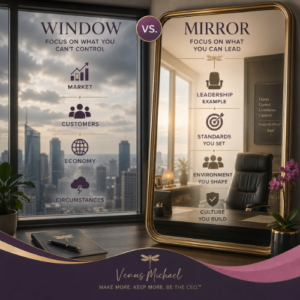
Not every problem is your fault.
Likewise, not every outcome can be controlled by leadership.
Nevertheless, leadership is the part you can begin changing immediately.
Ask:
- What have I modeled?
- What have I tolerated?
- What have I rewarded?
- What have I rescued?
- What expectation remains unclear?
- What behavior have I unintentionally made normal?
- What must I demonstrate differently going forward?
The purpose is not to excuse other people.
It is to stop giving away your ability to influence the result.
When leadership changes, the environment changes.
As the environment changes, people often begin responding differently.
Venus’ Bottom Line
Every business eventually reaches the leadership ceiling of the person leading it.
A lack of opportunity does not hold every business back.
Neither does a lack of talent or resources.
Sometimes the business can grow only as far as the leader is willing to grow.
The good news is that mirrors do not exist to criticize us.
They help us see clearly enough to improve.
Therefore, when you notice the same problem appearing again, do not ask only:
“Why do they keep doing this?”
Ask:
“What is my business reflecting to me?”
That question may feel uncomfortable.
It may also be the beginning of the most important leadership change you make.
Because the moment a leader changes, the business begins changing too.
Everything else is simply a reflection.