
If Your Business Needs You for Everything, It Owns You
To delegate effectively, leaders must transfer more than tasks.
They must also transfer ownership, authority, and enough context for another person to make sound decisions.
One of the hardest conversations I have with business owners usually begins the same way.
“I just can’t find anyone who does it the way I do.”
Sometimes they say:
“It will be faster if I do it myself.”
Other times, I hear:
“I tried delegating before, and it didn’t work.”
I understand exactly what they mean because I have said those same words myself.
When you build something from the ground up, letting go feels risky.
No one will care as much as you do.
Few people know the business as well as you do.
Additionally, nobody else understands every moving piece yet.
So you keep saying yes.
You continue solving the problems.
Every question still comes to you.
Meanwhile, you carry the mental weight of the business.
Eventually, you may realize something uncomfortable.
You did not build a company that operates through people and systems.
Instead, you built a job that only you know how to do.
How Do Great Leaders Delegate Effectively?
Great leaders delegate effectively by transferring ownership instead of simply transferring tasks.
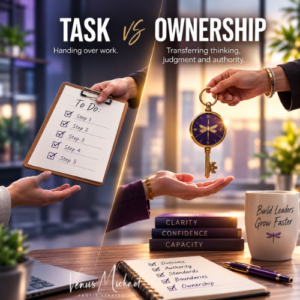
Anyone can hand someone a checklist.
Leadership requires more.
The other person needs to understand:
- The outcome
- Why it matters
- The standard
- The authority they have
- Which decisions they can make
- When they should ask for help
- What requires escalation
- How success will be measured
Effective delegation develops confidence and judgment.
Therefore, it is very different from assigning work and waiting to approve every step.
Unfortunately, many delegation attempts fail because the leader gives away the work while keeping all the thinking.
The Biggest Delegation Mistake
Most entrepreneurs make one delegation mistake without realizing it.
They transfer responsibility while holding on to authority.
The employee completes the task.
Then everything stops.
Can I send this?
Am I allowed to approve it?
What should I say?
Should I move forward?
Every decision still returns to the owner.
From the outside, this may look like delegation.
Inside the business, however, very little has changed.
The owner still carries the mental weight.
Meanwhile, the employee continues waiting for permission.
Work may leave the owner’s desk temporarily, but every meaningful decision comes back.
That is not delegation.
It is supervised task management.
Responsibility Without Authority Creates Dependence
Accountability requires the ability to act.

Yet many leaders ask employees to own results without giving them enough authority to make decisions.
For example, someone may be responsible for resolving customer concerns.
However, they cannot offer a reasonable solution without approval.
Another employee may own a project.
Still, that person cannot adjust the timeline, contact a vendor, or clarify priorities.
Likewise, a manager may be responsible for team performance while every hiring, scheduling, or coaching decision requires the owner.
In each case, responsibility exists without authority.
As a result, the employee becomes dependent.
Then the owner becomes frustrated because nobody takes ownership.
To delegate effectively, leaders must connect responsibility with appropriate decision-making authority.
Why Leaders Struggle to Let Go
Delegation is not difficult only because other people lack skill.
It is difficult because leaders are human.
Letting go means accepting that someone else may complete the work differently.
Not necessarily worse.
Just differently.
That can feel uncomfortable.
Your method may be faster because you have repeated it for years.
Your judgment may be stronger because you carry more context.
You may also notice risks before anyone else sees them.
However, those advantages can become a trap.
When the business relies only on your method, memory, and judgment, it can grow only at your speed.
Your speed has limits.
So does your time.
Eventually, your ability to touch every decision personally becomes the ceiling on the business.
Different Does Not Automatically Mean Wrong
Leaders often reclaim delegated work because it was not completed exactly as they would have done it.
Before stepping in, ask:
Was the outcome correct?
Did the work meet the agreed standard?
Was the approach reasonable?
Did it protect the customer and the business?
Was anything unsafe, unethical, or financially irresponsible?
When the outcome fails those tests, coaching or correction may be necessary.
However, if the result is sound, the difference may be style.
Delegation cannot succeed when the only acceptable approach is the owner’s exact approach.
The goal is not to create copies of yourself.
Instead, the goal is to build capable people who can produce strong outcomes.
The Leadership Ladder
One framework I use is called The Leadership Ladder.

It helps leaders transfer knowledge, judgment, and ownership in stages.
Those stages are:
- Watch me
- Let’s do it together
- You do it, and I’ll coach
- You own it
Each stage reduces dependency while increasing the other person’s confidence and authority.
Moving through the ladder takes more intention than handing someone a task.
However, it creates a much stronger result.
Stage One: Watch Me
This is where learning begins.
The employee observes the task while you demonstrate it.
However, do not show only what you do.
Explain why you do it.
Share what you notice.
Describe the risks you are considering.
Also clarify how you determine whether the result is good enough.
For example, do not simply demonstrate how you respond to a client complaint.
Explain:
- What outcome you want
- Which relationship you are protecting
- What authority exists
- What would require escalation
- Which language could make the problem worse
- How you know the issue has been resolved
The visible task is only part of the lesson.
The thinking behind the task matters just as much.
Stage Two: Let’s Do It Together
At this stage, the employee begins participating.
They may complete part of the work while you guide the process.
During that time, ask questions.
What do you notice?
What would you do next?
Which risk concerns you most?
What information is missing?
Why would you choose that response?
These questions reveal how the person is thinking.
In addition, they allow you to coach judgment before the employee works independently.
Avoid taking over simply because the first answer is imperfect.
Instead, help the person understand what they missed.
That is how people learn to think beyond the checklist.
Stage Three: You Do It, and I’ll Coach
This stage often feels uncomfortable for leaders.
The employee takes the lead while you remain available for support and review.
Mistakes may happen.
Questions will arise.
Progress may also be slower than it would have been if you had completed the work yourself.
Still, this is where confidence develops.
Not your confidence.
Theirs.
Give the person enough room to work through the process.
Then review the outcome together.
Ask what worked.
Discuss what they would change.
Clarify any missed standard.
Most importantly, resist the urge to rewrite everything in your own style.
Coach the gap without erasing their ownership.
Stage Four: You Own It
This is the goal.
Ownership means the person understands the process, purpose, standards, and authority surrounding the work.
They no longer need approval for routine decisions.
Instead, they know when to act and when to escalate.
They can solve predictable problems.
Furthermore, they can recognize when a situation falls outside the normal boundaries.
The leader remains accountable for the business.
However, the work no longer depends on the leader’s constant involvement.
You have not simply removed a task from your calendar.
You have developed another decision-maker.
That is how a business becomes more resilient.
Delegation Requires a Clear Outcome
Many leaders delegate activities instead of outcomes.
They say:
“Handle the client.”
“Take care of the report.”
“Manage the project.”
Those instructions may feel clear to the person giving them.
However, they often feel vague to the person receiving them.
A stronger delegation conversation defines the result.
For example:
“Own the client issue through resolution. Respond within one business day, explain the next step, and keep the relationship intact. You may approve solutions up to $250. Bring it to me if the client requests more than that or threatens legal action.”
Now the employee understands:
- The outcome
- The timing
- The authority
- The boundary
- The escalation point
Clarity creates the conditions for ownership.
Every Interruption Tells a Story
Pay attention to the questions your team asks each day.
Can I approve this?
What should I say?
How would you handle this?
Should we do this now?
Those questions are not simply interruptions.
They are clues.
Each one points to a place where the business may need:
- A principle
- A policy
- A process
- A clearer standard
- More authority
- Better training
- A defined escalation point
The goal is not to eliminate every question.
New situations will always create uncertainty.
Instead, focus on eliminating the same questions.
When people repeatedly ask for the same decision, the business is showing you where a system or leadership expectation is missing.
Create Decision Boundaries
People need to know which decisions they can make without asking permission.
A simple authority structure might include:
Decide and Act
The employee can make the decision independently and document the outcome.
Decide and Inform
The employee can act but should update the leader afterward.
Recommend and Confirm
The employee evaluates the options and brings a recommendation before acting.
Escalate Immediately
The issue exceeds the employee’s authority because it involves significant financial, legal, ethical, or reputational risk.
These boundaries reduce uncertainty.
They also prevent leaders from becoming involved in every routine choice.
As a result, employees gain confidence because they know where their authority begins and ends.
Delegation Is a Development Process
Many business owners try delegating once.
They assign a task.
The result disappoints them.
Then they decide delegation does not work.
However, one handoff is not a development process.
Delegation may require:
- Demonstration
- Documentation
- Practice
- Feedback
- Repetition
- Correction
- Additional context
- Increased authority over time
A person cannot absorb years of your experience during one conversation.
Therefore, expectations must remain realistic.
The goal is not immediate perfection.
The goal is progressive independence.
Hiring Does Not Automatically Create Capacity
The fourth pillar of The Dragonfly Effect™ is Capacity.
Many entrepreneurs assume capacity comes from hiring more people.
Sometimes it does.
However, hiring without delegation can create more people waiting for the owner.
More employees may mean more questions.
They may also create more approvals and interruptions.
In addition, the owner may end up with more work to review.
In that environment, headcount increases while leadership capacity stays the same.
Real capacity grows when the organization develops more people who can think and act responsibly.
The team needs to understand not only what to do but also how to make decisions.
That is when growth becomes sustainable.
You are not simply adding more hands.
You are developing more leaders.
Effective Delegation Builds Confidence
Delegation sends a message.
When you provide clear expectations, appropriate authority, and room to act, you communicate trust.
You are saying:
“I believe you can learn this.”
“I believe your judgment can grow.”
“You do not need to become me.”
“I expect you to own the outcome.”
That confidence matters.
People rarely become strong decision-makers while every decision is questioned, rewritten, or reclaimed.
They need meaningful responsibility and enough support to succeed.
Trust does not mean abandoning oversight.
Instead, it means using oversight to develop capability rather than preserve dependence.
Know When Not to Delegate
Not every decision belongs to someone else.
Leaders should remain closely involved when a decision concerns:
- Vision
- Culture
- Major financial commitments
- Legal or ethical risk
- Key hires
- Critical relationships
- Business model changes
- High-impact strategy
- Confidential matters
- Decisions outside the employee’s role or expertise
Effective delegation is not giving everything away.
It is assigning ownership thoughtfully.
Routine decisions should move closer to the people doing the work.
Meanwhile, high-impact leadership decisions should receive the attention they deserve.
The Hardest Part of Leadership
One of the most difficult shifts for me was accepting that people did not need to become copies of me.
They needed room to become the strongest versions of themselves.
That means allowing different strengths, personalities, and approaches.
One person may communicate more directly.
Another may build deeper relationships.
Someone else may see a process improvement I never considered.
Those differences can strengthen the business.
However, they cannot emerge when the leader requires imitation.
Leadership is not about cloning yourself.
It is about creating an environment where people can succeed without becoming you.
Conduct a Delegation Audit
Think about one task you still refuse to delegate.
Then ask:
Why Am I Still Holding It?
Does it truly require your expertise?
Or has it simply always belonged to you?
What Knowledge Exists Only in My Head?
Identify the judgment, context, standards, and exceptions someone else would need to understand.
What Authority Would Someone Need?
Determine which decisions they could make without approval.
Where Would They Need Coaching?
Consider what could be practiced before they own the work independently.
What Is the Real Risk?
Separate genuine financial, legal, ethical, or relationship risk from discomfort about someone using a different method.
Which Stage of the Leadership Ladder Comes Next?
Do they need to watch?
Should you complete it together?
Are they ready to act with coaching?
Could they own it now?
These questions turn delegation into a deliberate development plan.
Your Challenge This Week
Choose one task that should no longer depend entirely on you.
Do not simply hand it off.
Instead, identify its current place on the Leadership Ladder.
Then decide what the next stage requires.
Please have someone watch you complete it.
Maybe they are ready to work beside you.
They may already be capable of doing it with coaching.
In some cases, the only thing preventing full ownership is your willingness to release control.
Ask yourself honestly:
Is the problem truly that no one else can do this?
Or have I never built the confidence, systems, authority, and expectations that would allow someone else to succeed?
The answer may reveal your next leadership breakthrough.
Every task you refuse to release becomes another ceiling on the business.
Venus’ Bottom Line
Delegation is not about getting work off your plate.
It is about creating room for the business to grow beyond you.
The strongest leaders are not the people who can do everything.
They are the people who develop others to do extraordinary things without constant supervision.
One person can scale only so far.
Leadership scales through people.
Therefore, leaders who delegate effectively do more than assign tasks.
They build judgment.
Next, they transfer authority.
They also coach confidence.
Finally, when the person is ready, they allow genuine ownership.
Because when your business needs you for every task, question, and decision, you do not fully own the business.
The business owns you.

