
Four Financial Numbers Every CEO Should Monitor Monthly
CEO financial metrics do not need to include hundreds of reports, charts, and dashboards.
If I could choose only four numbers for a business owner to review every month, I would choose:
- Cash available
- Profit
- Owner’s pay
- Operating Margin
These are not the only numbers that matter.
But together, they tell the story every CEO needs to understand before making another major decision.
If I walked into your office tomorrow morning and told you that you could only look at four numbers every month, which four would you choose?
Revenue?
Profit?
Your bank balance?
Accounts receivable?
Most business owners pause before answering.
Not because they do not understand their businesses.
Because somewhere along the way, we were taught that better leadership means tracking more.
More reports.
More dashboards.
More KPIs.
More spreadsheets.
More charts.
The assumption is simple.
If we measure everything, we will make better decisions.
But after years of sitting across the table from entrepreneurs, I have discovered that the opposite is often true.
Too much information creates paralysis.
Great CEOs do not necessarily have more information.
They know which information actually matters.
Which CEO Financial Metrics Matter Most?
The four CEO financial metrics I believe every business owner should review monthly are:
- Cash available
- Profit
- Owner’s pay
- Operating Margin
Everything else provides context.
These four create clarity.
Together, they help answer four essential questions:
- What can the business safely use?
- Is the business model creating value?
- Is the business supporting its owner?
- Is the company becoming more or less efficient?
Those are leadership questions, not just accounting questions.
1. Cash Available
Notice that I did not say your bank balance.
There is a difference.
Your bank balance is a snapshot.
Cash available is a decision.

Cash available is the amount your business can confidently use after considering:
- Payroll
- Taxes
- Upcoming bills
- Debt payments
- Planned purchases
- Other committed expenses
I have watched owners make six-figure decisions because they looked at the balance in their checking account.
A week later, they were scrambling to cover payroll because quarterly taxes were due.
The goal is not simply knowing how much cash you have.
The goal is knowing how much cash you can safely use.
Those are two very different numbers.
A large bank balance can create false confidence when part of that money already belongs to payroll, taxes, vendors, or future obligations.
2. Profit
Profit is your business’s ability to create value.
Without profit, growth eventually becomes exhausting.
Profit is not whatever remains after all other expenses have been paid.
It is evidence that your business model works.
Too many entrepreneurs treat profit like leftovers.
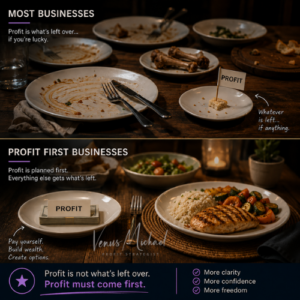
Something they will enjoy someday when the business finally gets bigger.
But someday has a way of never arriving.
Healthy businesses build profit intentionally.
Because profit is not simply a reward for the owner.
It creates resilience.
It provides options.
It supports future growth.
It gives the business room to survive mistakes, slow seasons, and unexpected expenses.
Profit is not optional.
It is a requirement for long-term sustainability.
3. Owner’s Pay
This number surprises some business owners.
I believe every CEO should know exactly what the business is paying them.
Not because this is only about lifestyle.
Because it is about sustainability.
I have met owners generating seven figures who quietly admitted they had not paid themselves consistently for months.
Meanwhile, I know entrepreneurs with smaller businesses who confidently pay themselves every month because they built financial systems that support it.
Revenue impresses people.
Owner’s pay tells me whether the business is working for the person who built it.
That leads to an uncomfortable but necessary question:
If your business cannot consistently support you, is it serving you, or are you serving it?
Owner’s pay should not be the mysterious amount that remains after everyone else has been taken care of.
It should be visible.
Intentional.
And connected to the business’s financial reality.
4. Operating Margin
Operating Margin is where many business decisions become visible.
It answers a simple question:
For every dollar your business earns, how much remains after normal operating expenses?
Margins reveal patterns long before revenue does.
When the operating Margin begins shrinking, something has changed.
Pricing may not have kept up with costs.
Maybe payroll increased.
Maybe software subscriptions accumulated.
Maybe internal processes became inefficient.
Maybe the business added complexity without adding enough value.
Revenue may still look healthy.
Operating Margin quietly tells you whether the engine is becoming more efficient or slowly wearing out.
That is why Margin deserves attention before the bank account becomes uncomfortable.
It can reveal a problem before you run out of time to make thoughtful decisions.
Why Only Four Numbers?
Because leadership is not about drowning in data.
It is about recognizing patterns.
Imagine flying an airplane.
The cockpit contains hundreds of gauges, switches, and indicators.
The pilot does not stare at all of them equally.
The pilot knows which instruments deserve immediate attention.
Business works the same way.
Your accounting software can produce hundreds of reports.
That does not mean your brain should process all of them every day.
Focus creates clarity.
Clarity creates confidence.
Confidence creates better decisions.
The goal is not to ignore the rest of the financial information.
The goal is to identify which numbers deserve your attention first.
The CEO Scorecard
Inside my own work, I think of these four numbers as The CEO Scorecard.

Not because they are the only metrics that matter.
Because they create better conversations.
Instead of asking:
“How much did we sell?”
The conversation becomes:
Did available cash improve?
Did profit improve?
Did I pay myself consistently?
Did our operating margin strengthen?
Did the business become healthier?
Those questions move leaders from activity to progress.
They shift the focus from how busy the business was to what the business actually produced.
The Numbers Are Not the Goal
Here is the mistake I see business owners make.
They start tracking numbers instead of understanding them.
Metrics do not change businesses.
Behavior changes businesses.
Numbers reveal behavior.
If profit is shrinking, something created that result.
If cash is disappearing, a decision or pattern caused it.
If the owner’s pay is not being paid, the business is trying to communicate something.
If operating Margin is falling, the company may be working harder while becoming less efficient.
The numbers are not judging you.
They are communicating with you.
The question is whether you are listening.
What Should You Do With These Numbers?
Reviewing the numbers is only the beginning.
For each metric, ask what changed and why.
For cash available, ask:
- What obligations are already committed?
- Is enough cash protected for taxes and payroll?
- Can the business withstand a slower month?
- What can we safely invest?
For profit, ask:
- Is profit improving or shrinking?
- Is pricing still supporting the business?
- Are expenses producing enough value?
- Is the business model becoming stronger?
For owner’s pay, ask:
- Am I paying myself consistently?
- Does my compensation reflect my role?
- Is the business supporting the life it was created to support?
- What needs to change if owner pay is repeatedly sacrificed?
For operating Margin, ask:
- Are costs growing faster than revenue?
- Has payroll become too heavy?
- Are we carrying unnecessary complexity?
- Are we becoming more efficient or less efficient?
The number tells you what happened.
The question helps you understand why.
A Challenge for Your Next Financial Review
Before you open your financial reports next month, ask yourself:
If I could only see four numbers, which ones would help me make the best decisions?
If your answer is a page full of reports, you may be measuring activity rather than progress.
The goal is not to know everything.
The goal is to know enough to lead well.
Venus’ Bottom Line
The best CEOs are not the ones with the biggest dashboards.
They are the ones who know which numbers deserve their attention.
Because clarity does not come from tracking more.
It comes from understanding what matters most.
Leadership begins the moment you stop asking for more reports and start asking better questions.
Here is what I would like you to think about today:
If you could only review four numbers next month, which ones would help you lead your business more confidently?


