
Can AI Replace a CFO or Business Advisor?
Can AI replace a CFO or business advisor?
The answer is no.
AI can analyze information, summarize financial statements, identify trends, build forecasts, and explain complex ideas in plain English.
What it cannot do is fully understand the human consequences behind a business decision.
It does not know what keeps you awake at night.
It does not know your risk tolerance.
It does not know what you promised your employees, what your family needs from you, or what kind of company you are trying to build.
AI can generate recommendations.
It cannot take responsibility for the consequences of those recommendations.

And that is a difference every CEO needs to understand.
A few months ago, someone asked me a question I knew was coming.
“With AI getting so good, are business advisors going to become obsolete?”
I smiled.
Not because it was a silly question.
Because it is one of the most important questions business owners should be asking right now.
Artificial intelligence has changed the way I work.
It has made me faster.
More efficient.
More creative.
It helps me organize information, identify trends, draft reports, and challenge my own thinking.
I use AI almost every day.
And I believe every business owner should be learning how to use it.
But here is what I do not believe.
AI is not replacing great advisors.
It is exposing the difference between information and wisdom.
What AI Can Do Well
AI is exceptional at processing information quickly.
It can:
- summarize financial statements
- identify unusual patterns
- compare current results with prior periods
- generate forecasts
- organize ideas
- draft reports
- explain accounting concepts
- surface possible risks
- create decision options
Those capabilities are valuable.
They save time.
They reduce repetitive work.
They allow business owners and advisors to move more quickly from data gathering to decision-making.
But speed is not the same as wisdom.
And a recommendation is not the same as a decision.
Why AI Cannot Fully Replace a CFO
The question is not whether AI can produce an answer.
It can.
The better question is whether AI understands the full context surrounding that answer.
A CFO or business advisor considers things that may never appear in a spreadsheet.
Your risk tolerance.
Your leadership style.
Your capacity.
Your team’s morale.
Your family obligations.
The promises you have made.
The timing of the decision.
The cost of being wrong.
The opportunity cost of waiting.
Two businesses can have the same financial data and still need completely different advice.
One owner may be ready to hire.
Another may need to stabilize cash flow first.
One company may need to raise prices immediately.
Another may need to simplify its services before asking customers to pay more.
AI can identify options.
A trusted advisor helps determine which option fits your actual business.
We Have Mistaken Information for Transformation
For years, business owners believed the missing piece was better information.
More reports.
More dashboards.
More metrics.
More spreadsheets.
Now AI can generate much of that in seconds.
So why are so many businesses still struggling?
Because information has never been the real bottleneck.
Implementation is.
Knowing what to do and actually doing it are two completely different skills.
Every January, thousands of entrepreneurs create business plans they never follow.
Not because the plan was bad.
Because consistency is hard.
AI can tell you to raise your prices.
A trusted advisor helps you decide:
- when to raise them
- how much to raise them
- which clients will be affected
- how to communicate the change
- what resistance to expect
- how to follow through without backing down
Those are not the same conversation.
Information may reveal the path.
Transformation requires action.
The Best Advisors Ask Better Questions
One of the biggest misconceptions about advisory work is that clients pay advisors for answers.
They do not.
They pay for better thinking.
Some of the most valuable moments I have had with clients did not happen because I delivered the perfect answer.
They happened because I asked a question they had not considered.
Questions like:
- What happens if you do not hire?
- Why are you assuming this is your only option?
- What would this decision look like six months from now?
- What problem are we actually trying to solve?
- What are you afraid will happen?
- What does success need to look like for you personally?
- What are you protecting by delaying this decision?
Those questions change businesses.
Not because they are magical.
Because they change the way leaders think.
And better thinking creates better decisions.
AI Is the Intern. You Are Still the CEO.
I like to think of AI as the smartest intern you have ever hired.
It works quickly.
It never gets tired.
It can research almost anything.
It can organize information faster than most people.
But would you hand the keys to your company to an intern on the first day?
Of course not.
You would expect that person to gather information.
Prepare analysis.
Identify possibilities.
Maybe even challenge your assumptions.
Then you would use your experience, judgment, values, and understanding of the business to make the final decision.
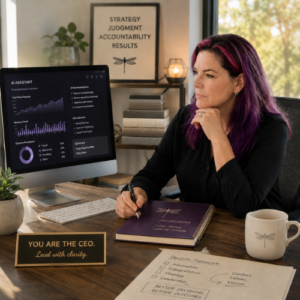
That is exactly how AI should be used.
It is an incredible assistant.
It is a terrible replacement for leadership.
The AI Decision Ladder
One framework I use when thinking about AI is what I call The AI Decision Ladder.
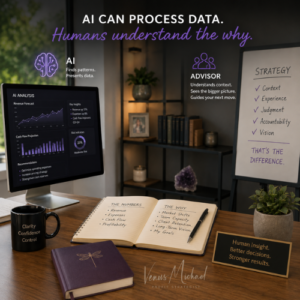
Every business decision moves through four levels.
Level 1: Information
What happened?
AI is exceptional here.
It can review financial data, summarize reports, identify trends, and highlight changes.
This is where speed matters.
Level 2: Interpretation
Why did it happen?
AI can help.
But context begins to matter.
Payroll, pricing, one-time expenses, seasonality, customer mix, or growth investments could reduce profit.
The data may show the result.
Understanding the reason requires more context.
Level 3: Strategy
What should we do next?
This is where experience becomes increasingly important.
Every business has different goals, risks, constraints, and priorities.
A technically correct recommendation may still be strategically wrong for a particular business.
Level 4: Leadership
Will we actually follow through?
This is where trust, accountability, communication, and courage live.
A business owner may understand exactly what needs to happen and still hesitate.
The decision may affect employees.
Customers.
Income.
Identity.
Relationships.
No algorithm can replace the human work required to lead through uncertainty.
Leadership has never been about simply knowing the answer.
It is about helping people make difficult decisions with confidence.
The Future Belongs to Advisors Who Use AI Well
I do not see AI as competition.
I see it as an amplifier.
The advisors who refuse to use it will eventually fall behind.
The advisors who rely on it completely will become interchangeable.
The advisors who combine technology with human judgment will create extraordinary value.
That is the future I am building toward.
Not replacing relationships with technology.
Strengthening relationships because technology reduces busywork.
The best advisors will spend less time manually building spreadsheets.
Less time organizing raw information.
Less time repeating work that can be automated.
And more time:
- listening
- challenging assumptions
- identifying trade-offs
- preparing leaders
- improving decisions
- creating accountability
- helping people follow through
AI should not reduce the value of the advisory relationship.
Used well, it should deepen it.
Business Has Always Been Human
Spreadsheets do not run businesses
People run them.
People with fears.
Ambitions.
Families.
Dreams.
Blind spots.
People do not lose sleep because a financial ratio changed.
They lose sleep wondering whether they can make payroll.
Whether they should hire.
Whether they can afford to lose a major client.
Whether they are making the right decision.
Those are not only accounting questions.
They are leadership questions.

And leadership requires someone who can listen, challenge, encourage, and help you see what you cannot see on your own.
How Should Business Owners Use AI?
Use AI to improve the quality and speed of your thinking.
Ask it to:
- organize financial information
- summarize reports
- identify trends
- generate possible explanations
- challenge assumptions
- compare scenarios
- prepare questions
- create a first draft
- uncover risks you may have missed
Then pause.
Before acting, ask:
Does this recommendation fit my business, my goals, and the kind of company I am trying to build?
Because the most efficient decision is not always the best one.
Sometimes the right decision is slower.
More thoughtful.
More human.
Sometimes it protects a relationship.
Preserves cash.
Supports your family.
Strengthens the team.
Or moves the business toward a long-term vision that cannot be reduced to one financial metric.
AI can help you identify options.
Wisdom helps you choose the right one.
Venus’ Bottom Line
Artificial intelligence is one of the most powerful business tools we have ever been given.
But tools have never built great companies.
People do.
Use AI to gather information.
Use it to increase efficiency.
Use it to challenge your thinking.
Use it to prepare better questions.
But do not outsource your judgment.
Because answers are easy to generate.
The courage to make the right decision still belongs to the leader.
Here is what I would like you to think about today:
Are you using AI to strengthen your judgment, or are you quietly asking it to replace it?