
Stop Solving Symptoms
To find the root cause of a business problem, begin by questioning the first explanation that seems obvious.
The issue demanding your attention may be real. However, it may only be a symptom of something happening deeper inside the business.
Weak sales do not always cause sales problems.
Cash shortages are not always caused by low revenue.
High expenses do not always cause declining profit.
Likewise, more growth is not always the answer.
One of the biggest mistakes I see business owners make has very little to do with money.
It has everything to do with assumptions.
A client once came to me convinced she had a marketing problem.
“I just need more leads,” she told me.
Her conclusion seemed logical.
Sales had slowed, and revenue had declined. Naturally, more leads felt like the obvious answer.
Instead of jumping into marketing ideas, I asked her to walk me through what happened after someone became a lead.
As we talked, the real issue became clear.
Her company was not losing customers because too few people were interested.
It was losing them because inquiries often went unanswered for three days.
By the time she responded, the potential client had already hired someone else.
She did not have a marketing problem.
She had a process problem.
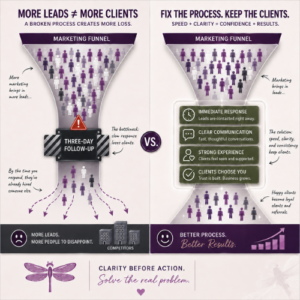
More marketing would not have fixed it. In fact, it would have created more people for the broken process to disappoint.
That is the danger of solving symptoms.
It makes you feel productive without correcting what is actually wrong.
How to Find the Root Cause of a Business Problem
Start by assuming that the first problem you notice may not be the complete problem.
Most business challenges have layers.
The visible issue sits on top. Underneath it, you may find a weak process, unclear responsibility, poor communication, inconsistent follow-up, faulty pricing, or a lack of capacity.
Therefore, the first answer should begin the investigation rather than end it.
Great CEOs do not stop with the first explanation that sounds reasonable.
Instead, they stay curious long enough to find the root cause.
That requires asking:
- What evidence supports this conclusion?
- What changed before the problem appeared?
- Where does the process begin to break down?
- Does this happen every time or only under certain conditions?
- What else could be creating the same result?
- Which assumption have I not tested?
- What problem would remain even if I fixed the symptom?
The goal is not to make every decision painfully slow.
Rather, the goal is to avoid moving quickly in the wrong direction.
Businesses Have Check-Engine Lights Too
Think about your car for a moment.
When the check-engine light appears, you do not solve the problem by covering the light with tape.
You do not disconnect the dashboard.
Nor do you assume the car is fine simply because it continues moving.
Instead, you investigate.
The light is not the engine problem.
It is a signal that something needs attention.
Businesses work the same way.
Common warning lights include:
- late customer payments
- recurring cash shortages
- high employee turnover
- shrinking profit
- repeated client complaints
- missed deadlines
- increasing refunds
- constant owner overwhelm
- frequent errors
- projects that never finish on time
Each symptom deserves attention.
However, the symptom itself may not tell you what needs to change.
A customer complaint might point to poor service. It could also reveal unclear expectations, weak onboarding, unrealistic sales promises, or an overloaded team.
Employee turnover could reflect compensation. On the other hand, it might come from poor training, unclear leadership, or inconsistent management.
Cash flow pressure may signal low sales. Yet delayed collections, weak pricing, debt payments, or project losses could create the same result.
The dashboard light gives you a starting point.
It does not give you the diagnosis.
Use the Five Whys to Find the Root Cause
One framework I use with clients is called The Five Whys.

The idea is simple.
When a problem appears, do not stop after the first answer.
Ask why.
Then ask why again.
Continue until you move past the visible symptom and reach the process, decision, or condition creating it.
The number five is not sacred. Sometimes the answer appears after three questions. In other cases, you may need six or seven.
What matters is refusing to stop too early.
Consider this example.
The visible problem
We are not making enough money.
Why?
Sales have slowed.
Why have sales slowed?
Referrals have declined.
Why have referrals declined?
We stopped asking satisfied clients for testimonials and introductions.
Why did we stop?
The team has been too busy to follow up consistently.
Why is the team too busy?
Our internal processes are inefficient, and administrative work is consuming too much time.
Now we are getting somewhere.
The original problem sounded like a sales problem.
Then it appeared to be a referral problem.
After a few more questions, the real issue became operational capacity.
If the company had stopped after the first answer, it might have spent thousands of dollars on advertising.
More leads would then have entered the same inefficient operation.
The company would have increased activity without increasing its ability to perform.
Why the First Answer Is Often Incomplete
Our brains prefer certainty.
When something goes wrong, we want an explanation quickly.
Uncertainty feels uncomfortable. Therefore, the first reasonable answer often becomes the accepted answer.
Sales are down.
We need more advertising.
Revenue declined.
We need more clients.
Profit decreased.
We need to cut expenses.
The team is overwhelmed.
We need to hire someone.
Maybe.
But maybe not.
The first explanation may describe what is happening without explaining why it is happening.
For example, hiring someone could help an overloaded team. However, it could also add cost and confusion if the real problem is poor delegation or an unnecessary process.
Cutting expenses may protect cash. Still, it may make the situation worse if the true cause is underpricing or slow collections.
More clients could increase revenue. Yet they could also overwhelm a delivery system that is already failing.
That is why strong leaders slow down before speeding up.
A short pause for investigation can prevent months of solving the wrong problem.
Solving the Wrong Problem Is Expensive
When you solve a symptom instead of the cause, you often create another problem.
Imagine that cash is tight.
The immediate response may be to cut spending.
Sometimes that is exactly the right decision.
However, consider a different possibility.
What if the company’s prices are too low?
Perhaps customers are paying late.
Maybe one service is consistently losing money.
The business might also be growing faster than its cash cycle can support.
In those situations, cutting resources does not correct the problem.
Instead, it may weaken service, reduce marketing, exhaust the team, or make future growth harder.
Meanwhile, the original cash problem remains.
Symptoms are expensive because they compete for attention and resources.
They encourage action before understanding.
As a result, the business spends money, time, and energy treating something that will continue returning.
Every Symptom Contains Information
A symptom is not useless.
It is evidence.
The mistake is treating one piece of evidence as the entire answer.
Suppose customer complaints have increased.
Rather than immediately retraining the service team, examine the full path:
- What was promised during the sale?
- How were expectations documented?
- Was the client onboarded properly?
- Did the team have the information needed to deliver?
- Were deadlines realistic?
- Did someone own communication?
- Did the problem begin after a recent change?
This investigation may confirm a service problem.
Alternatively, it may reveal that the sales process is promising outcomes the operations team cannot deliver.
That distinction matters.
One problem requires service training.
The other requires clearer offers, stronger sales boundaries, and better communication between departments.
Similar symptoms can require very different solutions.
Curiosity Is a Competitive Advantage
The best CEOs I have worked with do not pretend to know everything.
They ask strong questions.
For example:
- What else could be causing this?
- What changed before the problem began?
- Which assumption am I making?
- What evidence supports my conclusion?
- What evidence contradicts it?
- Who sees this problem differently?
- Where does the process work correctly?
- Could I be solving the wrong problem?
This kind of curiosity does not guarantee a perfect decision.
It does, however, improve the odds of making the right one.
Curiosity also creates better conversations with the team.
Instead of asking, “Who caused this?” a curious leader asks, “What allowed this to happen?”
That shift moves the conversation away from blame.
More importantly, it creates room to examine systems, expectations, training, tools, and decision-making.
Blame looks for a person.
Leadership looks for the pattern.
The Dragonfly Effect™ Starts With Clarity
One principle behind The Dragonfly Effect™ is that clarity comes before control.
You cannot control a problem you do not understand.

Many entrepreneurs work incredibly hard to regain control when something begins slipping.
They purchase new software.
They hire more people.
They launch another marketing campaign.
They add services.
They create more reports.
Yet if those actions are based on the wrong diagnosis, they create motion instead of progress.
Clarity is not passive.
It is investigative.
To find the root cause, you must remain with the problem long enough to understand how it developed.
Only then can you build the right process, assign ownership, measure performance, and create lasting control.
The order matters.
First, understand.
Then act.
A Root-Cause Review for Business Problems
The next time something feels wrong in your business, resist the urge to jump straight into solutions.
Instead, work through this review.
Step 1: Describe the symptom without interpreting it
Use observable facts.
For example:
- Response time increased from one day to three days
- Profit declined for three consecutive months
- Five employees left within six months
- Thirty percent of invoices are more than 30 days late
Avoid conclusions such as:
- The team does not care
- Marketing stopped working
- Customers are difficult
- We need more sales
Those are interpretations, not facts.
Step 2: Identify when the change began
Look for timing.
Did the issue appear after a new hire, new service, pricing change, software implementation, or increase in volume?
Timing may reveal an important connection.
Step 3: Follow the process from beginning to end
Do not examine only the point where the symptom appears.
Walk through every step leading to it.
Ask who owns each step, what information is required, and where work waits.
Step 4: Use the Five Whys
Keep asking why until the answer moves from a visible result to a process, decision, capacity issue, or untested assumption.
Step 5: Look for evidence
Data, observations, or repeated patterns should support a strong diagnosis.
One frustrating incident may not represent a company-wide problem.
Step 6: Test the smallest useful solution
Do not redesign the entire business before confirming the diagnosis.
Choose a focused change that allows you to test whether the suspected cause is correct.
Step 7: Watch the original symptom
After making the change, review whether the symptom improves.
When the symptom remains, continue investigating.
The purpose is not to defend the first diagnosis.
It is to find the root cause.
Two Questions to Ask Before Taking Action
Before solving your next business problem, pause and ask:
What evidence do I have that this is actually the problem?
Then ask:
What else could be true?
Those questions have saved my clients countless hours, thousands of dollars, and more than a few sleepless nights.
They create just enough space between the symptom and the reaction.
That space is where clearer thinking happens.
Businesses rarely improve because leaders solve problems faster.
They improve because leaders solve the right problems.
Venus’ Bottom Line
Symptoms demand attention.
Root causes create transformation.
The businesses that grow fastest are not always the ones that react first.
Instead, they are led by people willing to stay curious long enough to understand what is really happening.
Once you find the root cause, the right solution often becomes much clearer.
And when you solve the cause, the symptoms may disappear on their own.
Here is what I would like you to think about today:
Which problem in your business have you been trying to solve without first proving what is causing it?