Every Yes Costs You Something
Making better business decisions is not always about finding more opportunities.
Sometimes it is about understanding what each opportunity will cost you before you say yes.
One of the hardest words for entrepreneurs to say is not “no.”
It is “yes.”
Yes to the new client.
Yes to the partnership.
Yes to the networking event.
Yes to another service.
Yes to the software everyone is talking about.
Yes to squeezing in one more meeting.
Yes to taking on another project.
At first, all those yeses feel like growth.
Then, one day, your calendar is full. Your team is overwhelmed. Your margins are shrinking. Your attention is scattered.
And you are left wondering why success feels so exhausting.
The problem is not simply that you said yes.
The problem is that every yes came with a price you never calculated.
How Do CEOs Make Better Business Decisions?
CEOs make better business decisions by evaluating more than the obvious financial cost.
They also consider what the decision will require, what it will replace, how long its effects will last, and whether it supports the business they are intentionally building.
Every significant decision has at least two costs.
The first is obvious.
The money.
The second is hidden.
The opportunity you gave up by choosing something else.
Economists call this opportunity cost.
I call it The Cost of Yes.
Because every time you say yes, you are automatically saying no to something else.
Whether you recognize it or not.
Better Business Decisions Include the Invisible Invoice
Imagine someone handed you an invoice every time you made a business decision.
Not an invoice for the amount you spent.
An invoice for everything the decision required or replaced.
You hired a new employee.
Invisible invoice:
Less cash available for marketing, technology, reserves, or another hire.
You accepted another client.
Invisible invoice:
Less capacity for your current clients, your family, or a more profitable opportunity.
You launched another service.
Invisible invoice:
More marketing, training, delivery, support, documentation, and complexity.
You purchased another software platform.
Invisible invoice:
Another system your team must learn, manage, update, and remember to use.
Those invoices exist.
They simply do not appear as a separate line on your Profit and Loss statement.
Instead, they show up in your schedule.
Your team’s workload.
Your cash flow.
Your energy.
Your relationships.
Your ability to concentrate.
And sometimes, your peace of mind.
The financial price of a decision may be easy to identify.
Its full cost rarely is.
Better Business Decisions Protect the Company’s Focus
One of the biggest surprises I have experienced while working with successful companies is this:
They do not necessarily have more opportunities.
They simply ignore more of them.
That may sound backward.
But it is true.
Successful businesses eventually learn that focus creates momentum.
Distraction creates motion.

Those are not the same thing.
Motion makes you feel busy.
Momentum moves you deliberately toward something.
Some of the healthiest companies I have worked with have intentionally declined:
- Good clients
- Profitable projects
- Exciting partnerships
- New markets
- Additional services
- Attractive but distracting opportunities
They did not decline those opportunities because they were incapable of handling them.
They declined them because they understood what accepting them would cost.
Making better business decisions often means protecting the company from opportunities that are attractive but poorly aligned.
A capable business can do many things.
A strategic business chooses which things deserve to be done.
A Framework for Making Better Business Decisions
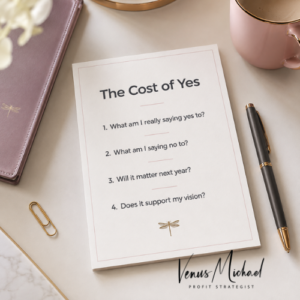
When I am faced with a significant business decision, I work through four questions.
I call this The Cost of Yes Framework.
It is not designed to make every decision slow or complicated.
It is designed to make the hidden tradeoffs visible before they become expensive.
Question One: What Am I Really Saying Yes To?
Do not stop at the obvious answer.
Look at the complete commitment.
If you are hiring someone, you are not only saying yes to their salary.
You are also saying yes to:
- Recruiting and onboarding
- Training and supervision
- Payroll taxes and benefits
- Leadership responsibilities
- Performance conversations
- New systems and communication needs
If you are launching a service, you are not simply saying yes to another source of revenue.
You are also saying yes to:
- Positioning it
- Pricing it
- Marketing it
- Selling it
- Delivering it
- Supporting it
- Improving it
- Training others to provide it
The opportunity may sound simple when it is introduced.
The commitment behind it may not be.
Every decision is bigger than it first appears.
Question Two: What Am I Automatically Saying No To?
This is where clarity begins.
Resources are limited.
Your money is limited.
Your team’s capacity is limited.
Your calendar is limited.
Your mental attention is limited.
Therefore, every commitment takes something away from another possible use of those resources.
If you say yes to another evening meeting, you may be saying no to dinner with your family.
If you say yes to another software platform, you may be saying no to simplifying your business.
If you say yes to a low-margin client, you may be saying no to the capacity needed for a stronger one.
If you say yes to solving another problem personally, you may be saying no to developing someone on your team.
Every yes closes another door.

That does not mean the decision is wrong.
It means the decision deserves to be made consciously.
Better business decisions become possible when the tradeoff is visible before the commitment is made.
Question Three: Will This Still Matter a Year From Now?
Urgency has a way of making everything feel important.
Perspective reminds us that very little actually is.
Some opportunities create a burst of excitement but no lasting value.
Others require more effort at the beginning but continue strengthening the business long after the initial decision.
Before committing, ask:
- Will this improve our position a year from now?
- Will this build a capability we will continue using?
- Will this create recurring value?
- Will it make the business healthier or merely busier?
- Will I still be grateful that I made this choice after the excitement wears off?
The businesses that scale well do not confuse urgent with meaningful.
They prioritize decisions that continue creating value.
A loud opportunity is not necessarily an important one.
Question Four: Does This Move Me Closer to the Business I Am Trying to Build?
This is the question that changes everything.
Not every profitable opportunity is aligned with your vision.
Not every potential client belongs in your future.
Not every service needs to become part of your business model.
Not every invitation deserves space on your calendar.
Some opportunities create revenue while pulling you further away from the business and life you actually want.
That is why the question cannot simply be:
“Can we do this?”
A stronger CEO question is:
“Does doing this help us become who we are trying to become?”
Capability is not the same as alignment.
You may be able to carry another client, attend another meeting, add another service, or manage another project.
That does not automatically mean you should.
The ability to separate capability from alignment is one of the foundations of better business decisions.
Better CEO Decisions Are Not Always About More
Entrepreneurs are naturally optimistic.
It is one of our greatest strengths.
We see possibilities.
Potential.
Opportunity.
We can look at an idea that does not exist yet and imagine what it could become.
The downside is that we can begin believing every possibility deserves our attention.
It does not.
More clients are not always better.
More services are not always better.
More revenue is not always better.
More employees are not always better.
More opportunities are not always better.
Sometimes “more” creates additional revenue while quietly consuming profit, focus, capacity, and quality of life.
The goal is not to build the biggest business possible.
The goal is to build the right business for the life you want to live.
That is a very different definition of success.
Some Businesses Grow by Doing Less
I have watched business owners improve revenue and profitability by doing less.
Not because they became lazy.
Because they became intentional.
They eliminated low-value work.
They raised prices.
They concentrated on their strongest clients.
They simplified their services.
They improved their systems.
They protected their calendars.
They stopped giving every opportunity equal access to their attention.
Instead of asking:
“How can we do more?”
They started asking:
“What should we stop doing?”
That question can create more growth than adding another product, promotion, or platform.
Subtraction is not always a retreat.
Sometimes it is strategy.
In many cases, better business decisions begin with subtraction rather than expansion.
Your Calendar and Financial Statements Reveal the Real Cost
If you want to know what you truly value, do not look only at your mission statement.
Look at your calendar.
Look at your spending.
Look at what receives your attention repeatedly.
Those things reveal your priorities far more honestly than your stated goals.
You may say that strategy matters.
Does it have space on your calendar?
You may say that profit matters.
Does your spending support it?
You may say that your family matters.
Does your availability reflect it?
You may say that leadership development matters.
Does your team receive the time, training, and authority it needs?
Every day, your decisions cast votes for the kind of business you are creating.
Eventually, those votes become your culture, financial results, and quality of life.
A Good Opportunity Can Still Be the Wrong Opportunity
This may be one of the hardest lessons for an entrepreneur to accept.
An opportunity does not need to be bad for you to decline it.
A client can be kind and still be a poor fit.
A project can be profitable and still require too much capacity.
A partnership can be exciting and still distract you from your central strategy.
A networking event can be valuable and still not be the best use of your evening.
A decision does not become right simply because it has benefits.
Most choices have benefits.
The CEO’s responsibility is to determine whether those benefits are worth the complete cost.
That requires more than optimism.
It requires discernment.
Make Better Business Decisions Before Saying Yes
The next time an opportunity comes your way, pause before allowing excitement or urgency to make the decision.
Ask yourself:
- What am I really committing to?
- What will this decision prevent or replace?
- Will it continue creating value a year from now?
- Does it move me toward the business and life I am intentionally building?
Then ask one final question:
If I say yes to this, what am I saying no to?
Not because opportunities are bad.
Because intentional decisions build intentional businesses.
This short pause can lead to better business decisions because it separates immediate excitement from long-term value.
The strongest CEOs do not chase every opportunity.
They protect their focus.
Venus’ Bottom Line
Every decision has a price.
Some prices are paid with money.
Others are paid with time, energy, relationships, capacity, focus, and peace of mind.
The most successful CEOs I have met are not successful because they said yes more often.
They are successful because they became incredibly thoughtful about what deserved a yes in the first place.
Every yes comes with an invisible invoice.
Read it before you sign it.
Because every yes shapes the business you are building.
Eventually, it also shapes the life you are living.
The next opportunity may be good.
But is it good enough to deserve what it will cost you?